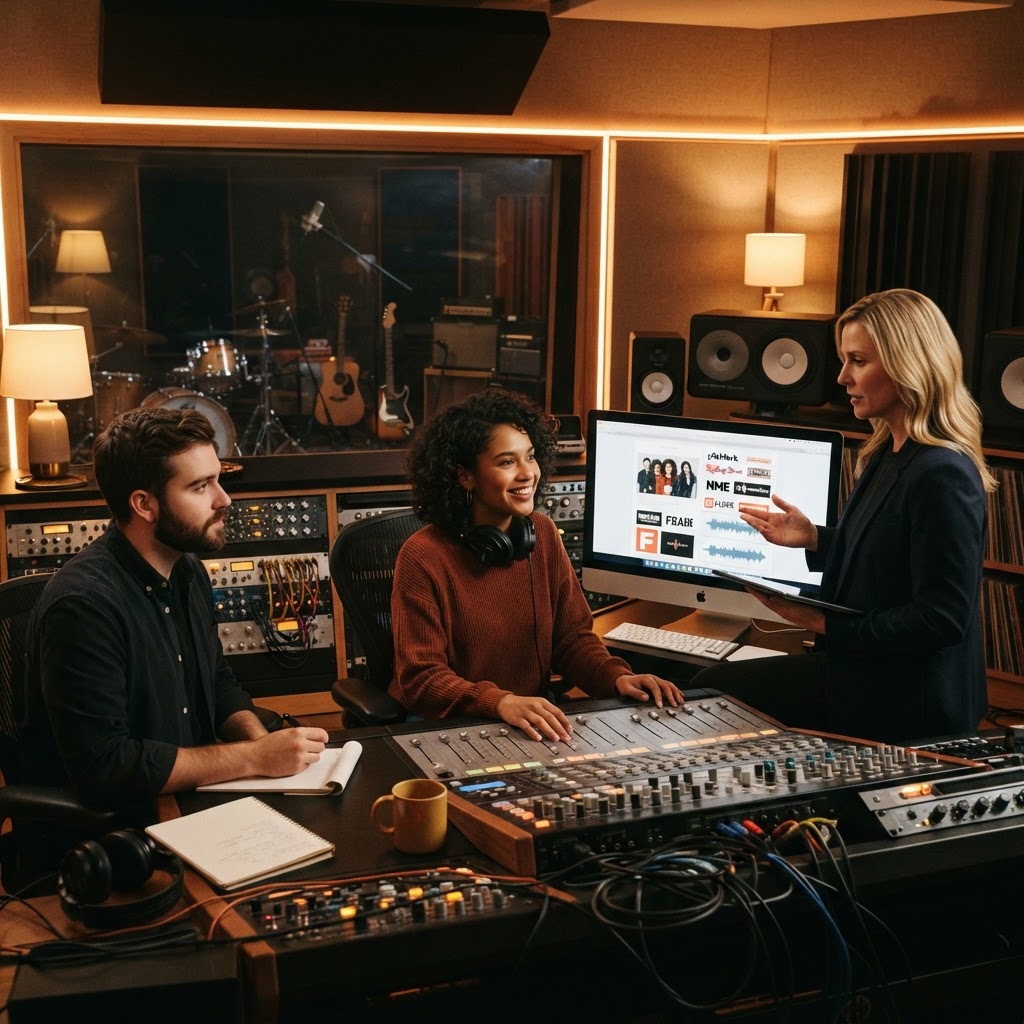
Why You Are Being Ignored: The Reality of Music PR
You have spent months writing, recording, and mixing your latest EP, only to be met with total silence after sending fifty personalized emails to music bloggers and playlist curators. This is the exact frustration that drives thousands of musicians to search for the best music PR tools for independent artists. You are not alone; the industry is currently saturated with over 100,000 new tracks uploaded daily, meaning your pitch has less than a three-second window to capture a journalist's attention before it is archived or deleted. The noise level in the music industry has reached a fever pitch, and the gatekeepers—blog editors, radio programmers, and playlist curators—have become increasingly defensive, creating a nearly impenetrable wall of inbox management software and strict editorial guidelines.
The best music PR tools for independent artists are platforms that bridge the gap between your music and verified media contacts. By leveraging integrated databases, AI-driven pitch refinement, and targeted distribution, these tools increase your open rate from a dismal 5% industry average to a competitive 20-30%, allowing you to secure credible coverage without a traditional PR firm.
The Anatomy of a Failed Pitch: Data-Driven Reasons Your Emails Fail
Most independent artists treat music PR like a lottery, hoping that mass-emailing a generic press release will yield results. However, the data proves otherwise. Industry benchmarks show that a generic blast to 500 contacts typically results in a response rate of under 1%. Why? Because curators and journalists use sophisticated spam filters and internal vetting systems that flag non-personalized content immediately. If your email contains "To Whom It May Concern" or "Dear Editor," your chances of getting a response drop by nearly 85%.
To fix this, you must understand the psychology of the gatekeeper. A music blog editor manages roughly 200 pitches per week. They are looking for specific metadata: High-resolution press photos, a clearly articulated narrative, and an active social presence that proves an existing audience. When you utilize the best music PR tools for independent artists, you gain access to the specific criteria each curator requires, saving you from wasting time on outlets that don't cover your genre. The technical barrier to entry is higher than it was even two years ago; now, journalists check your Spotify for Artists profile to see if your monthly listener count reflects the "buzz" you are claiming in your pitch. If your stats don't align with your narrative, the pitch is discarded.
How Do I Know If My Music Is Ready for PR?
Before using any PR tool, you must hit the 'Quality Threshold.' This means having at least three months of consistent streaming data and a minimum of 1,000 monthly listeners. If your track is brand new and has zero traction, a journalist will likely view it as 'unvetted.' Use SongBiz to build your momentum through playlist pitching and AI content creation first, then pivot to PR outreach once your metrics hit the baseline that professional outlets require. Without this baseline, you are essentially asking a stranger to gamble their editorial reputation on an unknown quantity. Data serves as your primary social proof; it tells the journalist that real human beings have already decided your music is worth listening to.
Insider Truth: PR is not a launchpad; it is an amplifier. Never waste your budget on a publicist or professional tool until you have social proof—otherwise, you are just paying to broadcast your lack of audience to the world.
Using the Best Music PR Tools for Independent Artists to Build Relationships
Building long-term media relationships requires moving beyond a one-time pitch. The best music PR tools for independent artists allow you to track who opens your emails and who clicks your press kit links. This data is gold. If a writer opens your email three times but does not reply, they are interested but likely waiting for more context or a clearer angle. This is your cue to send a follow-up pitch, not a reminder, but a new piece of content like a behind-the-scenes video or a live acoustic version. Many artists fail by sending redundant follow-ups that simply ask, "Did you get my last email?" This is aggressive and often results in being blacklisted from that publication's submission list.
What Are the Best PR Platforms for Low-Budget Artists?
For artists starting with zero budget, the focus should be on high-value, low-cost outreach. SongBiz provides an all-in-one platform where you can pitch to vetted Spotify curators and PR outlets through a single dashboard. By centralizing your outreach, you avoid the administrative bloat that usually requires a label or an expensive firm. Use the SongBiz AI Content Studio to generate high-quality press assets like bios and social clips, which are essential for standing out. These tools provide the necessary infrastructure to manage hundreds of contacts without the need for manual spreadsheet tracking, which is prone to human error and missed opportunities.
The Technical Mechanics of Media Outreach: Setting the Bar
SongBiz for Artists
Pitch your music to vetted curators and PR outlets — all in one platform
SongBiz handles playlist pitching, press outreach, booking, grant funding, and AI content creation so you can focus on making music. No label required. Start free and launch your first campaign in minutes.
Start free with SongBiz →Most musicians fail because their press kits are too heavy or disorganized. Your kit must contain: 1) A Google Drive or Dropbox link (no massive attachments), 2) A 300-word bio that focuses on your 'why' rather than your 'what', 3) Two professional press photos (one landscape, one portrait), and 4) A clear link to your music. When using the best music PR tools for independent artists, you should be able to create a standardized 'press portal' that tracks every download and click. This data lets you identify which outlets are actually engaged with your brand. If a journalist downloads your high-res image, you have a 40% higher probability of getting a feature within the next 72 hours. These small, technical signals are the indicators you must learn to read to master your own public relations strategy.
Are Paid PR Services Worth the Cost?
Paid PR agencies generally charge between $1,500 and $5,000 per month. If you are an independent artist without at least $50,000 in annual revenue, this is rarely a viable ROI. Instead, use the best music PR tools for independent artists to manage your own campaigns. By managing your own Meta ad campaigns—specifically using tools like SongBiz Meta BOOST to target listeners by micro-genre—you can generate more streams and authentic fans than an expensive publicist could ever guarantee through placement. The goal is to build an audience that cares, not just a list of placements that provide no meaningful career growth or long-term engagement.
Mastering the Pitch: 5 Actionable Steps to Get Coverage
- Personalize the First Line: Reference a specific article the journalist wrote in the last month. This proves you are not a bot and validates their work.
- Keep Subject Lines Under 50 Characters: Use a format like 'PR Pitch: [Genre] Artist [Name] – [Single Title]'. Research shows this maximizes mobile open rates.
- Leverage the 'SongBiz Advantage': Use the platform to match your music with the correct genre curators. Pitching country to a synth-pop blog will ruin your reputation instantly and result in permanent blocks.
- Build a Lead List: Use free tools like Chartmetric or your own SongBiz dashboard to find which journalists cover your soundalikes. Focus on the 'second-tier' blogs with high engagement rather than the major industry sites that rarely accept independent submissions.
- Monitor Conversion Rates: If your email open rate is below 20%, rewrite your subject line. If your click-through rate is below 5%, rewrite your bio or change the track link.
Pro Tip: Never ask a journalist to 'support' your music. Frame your pitch as a service to their audience: 'I thought your readers would love this because it features the same production style as [Artist they just wrote about].'
Advanced PR Strategies: Scaling Without a Label
As you grow, your media presence should evolve into a portfolio of reviews, interviews, and feature placements. This is what agencies refer to as 'social proofing.' When you pitch to larger outlets later, they will look for these previous features as a sign of trust. If you have no history, the best music PR tools for independent artists help you manufacture this history by starting with micro-blogs and neighborhood podcasts, effectively creating a 'pyramid' of coverage that leads to major features. This incremental growth is the only sustainable way to build a reputation in the modern music ecosystem.
How Can I Automate My Media Outreach?
You shouldn't automate the *personalization* of your pitch, but you can automate the *delivery*. Use scheduling tools to ensure your emails arrive between 9:00 AM and 11:00 AM on Tuesdays, Wednesdays, and Thursdays. These are the peak engagement windows for music editors. Consistency here matters more than intensity; sending ten high-quality, researched pitches a week is infinitely better than fifty generic ones. Automation is not a substitute for human connection; it is a tool for logistical optimization.
Why Do Many Bloggers Ignore High-Quality Music?
Bloggers often ignore great music because the pitch lacks context or professional formatting. Journalists need to know if you are touring, how your previous releases performed, and if you have upcoming collaborations. If your pitch is just a link to a song, it lacks the "story" they need to write an article. Always provide a full press deck or at least a detailed electronic press kit link.
FAQ: Answering the Most Common PR Hurdles
How often should I send a follow-up email to a journalist?
Send your first follow-up exactly seven days after the initial pitch. If you do not receive a response after the second email, archive that contact. Do not harass journalists; their time is their currency, and burning a bridge by being annoying is a permanent mistake in the music industry. Patience and professional boundaries are traits of serious, label-ready artists.
What is the most important element of an electronic press kit?
The most critical element is the 'story.' Journalists are not looking for music; they are looking for stories to tell their readers. If your bio sounds like a generic resume, it will be ignored. Tell them who you are, why you make music, and what makes this release unique. Human interest angles—like a unique recording process or a specific community impact—often garner more attention than the music itself.
Are blog placements actually worth the effort in 2024?
Yes, but not for the direct traffic. Blog placements act as 'trust signals' for curators and algorithms. When a reputable site links to your music, it improves your 'Artist Score' in databases that platforms like Spotify use to verify legitimate, buzz-worthy artists for algorithmic playlist placement. These backlinks create a digital footprint that proves your legitimacy in the eyes of automated systems, making it easier for you to land on Discover Weekly and Radio playlists.
Can I really do professional PR without a background in media?
Absolutely. The best music PR tools for independent artists provide the templates, contact databases, and data analytics that publicists use behind closed doors. By utilizing an all-in-one platform like SongBiz, you gain access to the same logistics—pitching, content creation, and campaign tracking—without needing a degree in communications or an expensive industry contract. Professional PR is essentially the art of project management; as long as you have the data and the discipline to execute, you are already halfway there.
What is the "PR Threshold" for seeking larger publications?
You should only target Tier-1 publications once you have at least 15-20 credible placements on smaller, independent blogs. Larger outlets require a "trail of evidence" to ensure their writers aren't taking a risk on an unproven talent. Use SongBiz to catalog your growing list of smaller features so you can include this list in your next big pitch, demonstrating that you are an established, rising act.
Build your music career without a label
Join thousands of independent artists using SongBiz to get playlist placements, press coverage, booking deals, and grant funding — all from one platform. Start free today.
SongBiz Professional — Pitch. Press. Play. The all-in-one music marketing platform for independent artists. Playlist pitching, PR outreach, booking, grant funding, and AI content creation. Start free →