How to Book Your First Tour Without a Booking Agent
You have spent thousands on recording, invested in social media, and yet the dream of playing live across the country remains a distant, expensive memory because you don't know how to book your first tour without a booking agent. It is a crushing reality: you have the talent, but without a professional representative, venues treat your emails as spam and your inbox stays empty. To master how to book your first tour without a booking agent, you must transition from 'musician' to 'touring operation' by leveraging data, targeted outreach, and professional presentation. Successfully securing a run of dates requires building a routing map that minimizes travel costs while maximizing venue foot traffic, pitching with localized proof-of-concept, and treating every show inquiry like a high-stakes B2B sales negotiation. Start by identifying your target region where your listener density is highest—use your Spotify for Artists data to isolate cities with at least 500+ monthly listeners—and build a schedule that keeps travel under 300 miles between dates to preserve your budget.
The Data-Driven Approach: Mapping Your Route
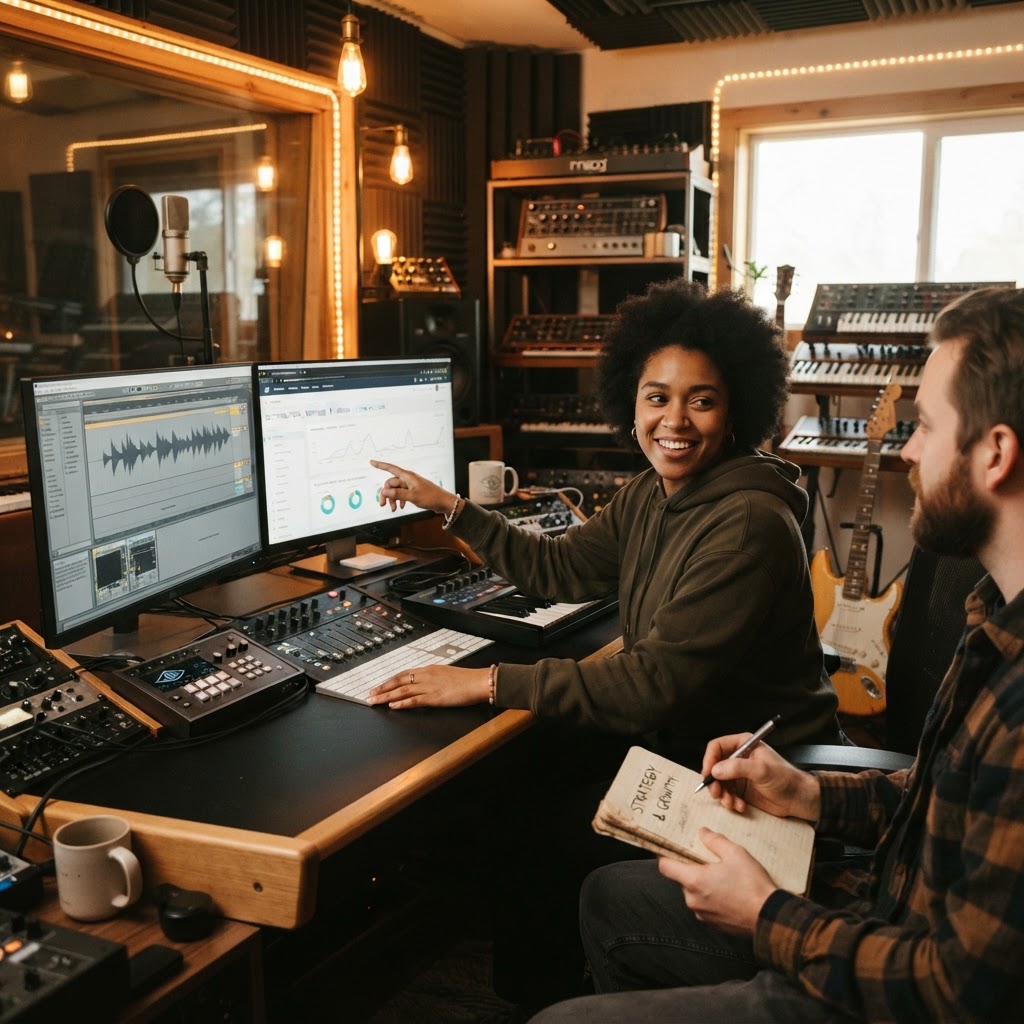
Before you send a single email on how to book your first tour without a booking agent, you need a 'Draw Map.' Agents don't guess; they look at heat maps. If you have 200 listeners in Chicago and 20 in Indianapolis, Chicago is your anchor date. The biggest mistake artists make is 'touring in a vacuum,' where they book cities they like rather than cities that like them. You need to identify a minimum threshold of 300-500 monthly listeners per city to justify a club show that doesn't result in a 'guarantee' of zero dollars. SongBiz allows you to streamline this research by connecting with vetted curators and PR contacts who can help boost your profile in those target markets before you even reach out to venue managers. Your goal isn't just to play; it's to build a route that is logically defensible to a skeptical booker.
Consider the "hub and spoke" model: establish one anchor city where you can perform two nights back-to-back, then radiate out into secondary markets. If your data shows a spike in Salt Lake City, build a three-day weekend around that specific market. Use geolocation data to determine where your fans reside, not just where they stream. If 40% of your listeners are in suburban counties rather than the city center, look for "suburban clubs" or collegiate venues that cater to that specific demographic. This drastically reduces the competition for stage time compared to the major downtown venues, which are often booked 6 to 12 months in advance.
How to Write a Venue Pitch That Actually Gets Opened
What are the critical success factors for cold-emailing venue bookers?
Venue bookers are bombarded by hundreds of emails daily. When learning how to book your first tour without a booking agent, your subject line is your greatest asset. Forget 'Booking Inquiry: [Band Name].' Instead, use: '[Band Name] - [Number] Monthly Listeners - [Date] - [Venue City].' Bookers care about one thing: Risk mitigation. They want to know you will bring bodies to the bar. Include a link to a live video (not a high-production music video) that shows crowd engagement. A shaky, 30-second phone clip of a room singing along is worth more than a $5,000 studio music video. SongBiz’s AI Content Studio can help you quickly repurpose your best performance footage into punchy, professional reels that demonstrate this 'draw' factor, making your pitch impossible to ignore.
Beyond the subject line, the body of your email must be under 150 words. A common mistake is including a biography longer than your touring history. A booker doesn't need to know your artistic journey; they need to know your financial impact. Structure your pitch as follows: First, your "anchor date" or "routing viability" (explain that you are already playing in City X on Tuesday and City Z on Thursday, making City Y a logistical fit). Second, provide your "draw potential"—state your Spotify monthly listener count in the specific zip code, not just your total global count. Third, include three links: one to a live video, one to a representative track, and one to your EPK. If you cannot provide a live video, provide a link to a high-quality video of a rehearsal or a professional acoustic set. The goal is to prove you can perform the material competently in a room setting.
Pro Tip: Never ask a booker 'Is this date available?' Instead, present an offer: 'I have a routing opening for [Date] in [City]. We are looking to fill this slot with a bill of [Genre] artists. Are you currently booking that mid-week window?'
Building Your 'Proof of Performance' Portfolio
Even if you are DIY, you must present as a professional entity. When you investigate how to book your first tour without a booking agent, your EPK (Electronic Press Kit) acts as your proxy. It must contain high-resolution press photos, a clear link to your music, and, most importantly, a list of 'Recent Live Highlights.' If you haven't played much yet, highlight your Spotify engagement data or recent PR wins. SongBiz serves as your all-in-one platform for this; by using their tools to secure playlist placements and press coverage, you create an 'external validation' loop that tells a venue: 'This artist is being noticed, and I should book them before they get bigger.'
Your EPK should also include a "Stage Plot" and an "Input List." Even if you are a three-piece band, providing a professional PDF document outlining your technical needs shows that you have toured before—or at least possess the professionalism of an act that has. This signals to the sound engineer that you are not going to be a headache. The more "plug and play" you are, the more a venue will want to book you. If you show up with a complicated 45-minute soundcheck requirement for a local support slot, you will not be asked back. Emphasize "Fast Turnover" capability in your communications to secure those lucrative support slots for larger touring acts passing through your city.
Financial Viability: Managing the Tour Budget
SongBiz for Artists
Pitch your music to vetted curators and PR outlets — all in one platform
SongBiz handles playlist pitching, press outreach, booking, grant funding, and AI content creation so you can focus on making music. No label required. Start free and launch your first campaign in minutes.
Start free with SongBiz →How do you ensure you don't lose money on your first tour?
Touring is expensive. To book your first tour without a booking agent, you need to calculate your 'Break-Even Point' (BEP) for every single night. Factor in gas, tolls, food, lodging, and merch costs. If your guarantee is $200 but your gas and food for the day is $250, you are losing money on the show unless your merch sales cover the gap. Aim for a 3:1 ratio on merch: if you have 50 people in the room, you should aim to convert 10% into buyers. Use Meta BOOST, integrated within the SongBiz platform, to run targeted ads in the cities you are visiting 14 days before your arrival. This increases your 'pre-show' buzz and ensures that when you arrive, there are actual paying fans waiting.
You must also account for "hidden" costs like parking in major urban centers and the cost of an extra hotel room if your van isn't equipped for sleep. Many first-time tourers fail because they calculate the cost of gas but ignore the cost of "per diems." If you are a three-person band, a $300 guarantee rarely covers the cost of three meals, two tanks of gas, and a hotel. To survive, prioritize "couch surfing" with fans you've engaged online—this is a common industry practice for developing artists. Reach out to your top Spotify listeners in each market and ask if they would be willing to host you in exchange for merch or VIP entry. This keeps your overnight costs at zero and builds a deep, long-term connection with your superfans.
How do you determine the optimal duration for a first-time DIY tour?
For your first tour, cap your debut run at 7 to 10 days. This duration is long enough to establish a routine and test your stamina, but short enough to keep burnout at bay. The goal is to build a successful "template" for a tour that you can repeat. If you survive a 10-day run while maintaining profitability, you have validated your business model and are ready to expand your geographic footprint for your next excursion.
The Logistics of Venue Negotiation and Contracts
Once a venue shows interest in your email inquiry, do not stop. You are now in a negotiation. A common trap is accepting a 'door deal' without asking for the 'split.' A pro structure is 80/20 in your favor after the venue covers its basic expenses (sound tech, etc.). When you learn how to book your first tour without a booking agent, you must master the 'deposit' talk. Do not confirm a date until you have an email confirmation of the guarantee and the sound check time. If a venue refuses to discuss terms, they are likely not serious. Always have a simple contract template ready to send. It adds a layer of legitimacy that separates hobbyists from touring professionals.
Understand the difference between a "Flat Guarantee" and a "Door Deal vs. Guarantee." A flat guarantee is the safest route for a beginner; the venue pays you $X regardless of attendance. A "versus" deal is riskier; you get the guarantee *or* a percentage of the door, whichever is higher. If the venue insists on a "percentage of the door," always define the "room rental" or "house nut" (the venue's fixed expenses). Never let a venue claim an opaque "house nut" that eats your entire cut. Ask for a breakdown: "What is your typical production cost for a Tuesday night?" Transparency is the hallmark of a professional musician who knows their worth.
Insight: The most successful independent artists aren't the ones with the most streams; they are the ones with the most repeatable markets. A tour isn't a vacation; it's a series of business transactions in different zip codes.
Leveraging AI and Tools for Scaling
You cannot scale your career if you spend 40 hours a week sending manual emails. By using tools like SongBiz for outreach and AI content generation, you can condense your administrative workload by 70%. When you are on the road, you still need to be 'prepping' the next leg. Spend your travel time using your dashboard to manage PR outlets and sync opportunities. If you are not pitching, you are stalling. The most effective way to understand how to book your first tour without a booking agent is to build a recurring cycle: Research -> Pitch -> Market -> Perform -> Repeat. If you are doing these steps effectively, you will be able to show venue managers a trajectory of growth that justifies higher guarantees for your second tour.
Consider using AI-driven CRM tools to track your contact history. If you pitch a venue in Nashville and they decline due to a schedule conflict, mark the date in your CRM for a follow-up three months prior to your next proposed date. Venues appreciate persistence, provided that persistence is professional and respectful of their busy schedules. By maintaining a centralized database of "Yes," "Maybe," and "Not Right Now" venues, you build a proprietary asset that eventually becomes more valuable than any generic list of contacts you could buy. This is how you transition from an amateur emailing blindly to a touring business owner with a multi-year road strategy.
FAQ: Mastering the Independent Tour
How many songs should I have released before booking my first tour?
You should have at least 15–20 minutes of solid, high-energy original material. It is less about the number of songs and more about the quality of the 'set.' If you can hold an audience's attention for 30 minutes, you are ready to book. Prioritize quality over quantity; a tight 30-minute set is better than a sluggish 60-minute one.
What should I do if a venue ignores my follow-up email?
Wait exactly five business days before sending a polite, brief follow-up. Keep the subject line the same so the email thread stays together. If they don't respond to the second email, move on. Venue bookers are often overwhelmed, but if you have sent two professional emails with data-backed interest and received no response, your time is better spent on a venue that is actively engaging.
How do I calculate a realistic door deal for a small club?
Calculate your daily overhead (gas, food, lodging) and ensure the deal covers at least 150% of those costs. If the venue offers a 'door split,' ask for a 'guarantee' against the door. This means you get the higher of the two: the base fee or the agreed-upon percentage of ticket sales. Always prioritize a guarantee for your first tour to ensure you can pay for fuel.
Can I really secure a tour without any prior PR or playlist press?
It is possible but significantly harder. Venues use press coverage as social proof. If you don't have PR, use your Spotify metrics. If you have high 'save rates' or 'listener growth,' highlight that. SongBiz helps bridge this gap by allowing you to pitch for press and playlist placements, providing you the 'social proof' necessary to convince a venue booker you are worth the stage time.
What happens if I encounter technical issues on the road?
Carry a "Road Repair Kit." This should include extra instrument cables, gaffer tape, a soldering iron, and spare tubes if you play through amplifiers. Being able to fix your own gear keeps you from missing a performance—which is the only way to ensure you get paid. Always check in with the sound engineer immediately upon arrival, offer a small token of respect (like a beverage), and be ready to troubleshoot your own sound in 10 minutes or less.
Ultimately, your first tour is an investment in your career capital. Even if you finish the tour with a net zero in your bank account, you have gained a portfolio of "Proof of Performance." Use this to book your second, more profitable tour. Every successful touring artist started exactly where you are today—by taking the initiative to pick up the phone, write the pitch, and prove their value one venue at a time.
Build your music career without a label
Join thousands of independent artists using SongBiz to get playlist placements, press coverage, booking deals, and grant funding — all from one platform. Start free today.
SongBiz Professional — Pitch. Press. Play. The all-in-one music marketing platform for independent artists. Playlist pitching, PR outreach, booking, grant funding, and AI content creation. Start free →