
How to Get Fans to Support Your Music Financially: The Proven Strategy
You’ve spent thousands on production and months on social media, yet your royalty check barely covers a single tank of gas. You are asking yourself how to get fans to support your music financially because the traditional model of relying on streaming pennies is failing you. The frustration of stagnant growth and a silent merch store is real, but it is solvable through strategic audience segmentation and direct-to-fan value exchange. The professional transition involves moving away from the "exposure" myth and into the reality of "conversion architecture."
To get fans to support your music financially, you must shift your mindset from 'streaming artist' to 'ecosystem architect.' Implement a tiered value strategy: offer free access for discovery, paid 'insider' tiers for super-fans, and high-ticket exclusive experiences. By utilizing SongBiz to manage your PR and playlist pitching alongside targeted ad campaigns, you build the infrastructure required to convert casual listeners into long-term financial patrons. Sustainability in the current market requires treating every listener interaction as a potential step in a complex revenue funnel, rather than a singular event.
The Math of Fan Conversion: Turning Listeners into Revenue
The industry benchmark for 'super-fan' conversion is between 1% and 3% of your total monthly active listeners. If you have 10,000 monthly listeners, you should mathematically be able to support a recurring revenue model of 100 to 300 paying fans. If you are below this, the issue is not your music; it is the lack of a clear financial funnel. We define a "Core Conversion Threshold" as the point at which your data confirms that a listener has moved from passive streaming to intentional engagement. This threshold is usually crossed when a listener signs up for an email list, follows your social channels, or interacts with a piece of long-form, non-musical content.
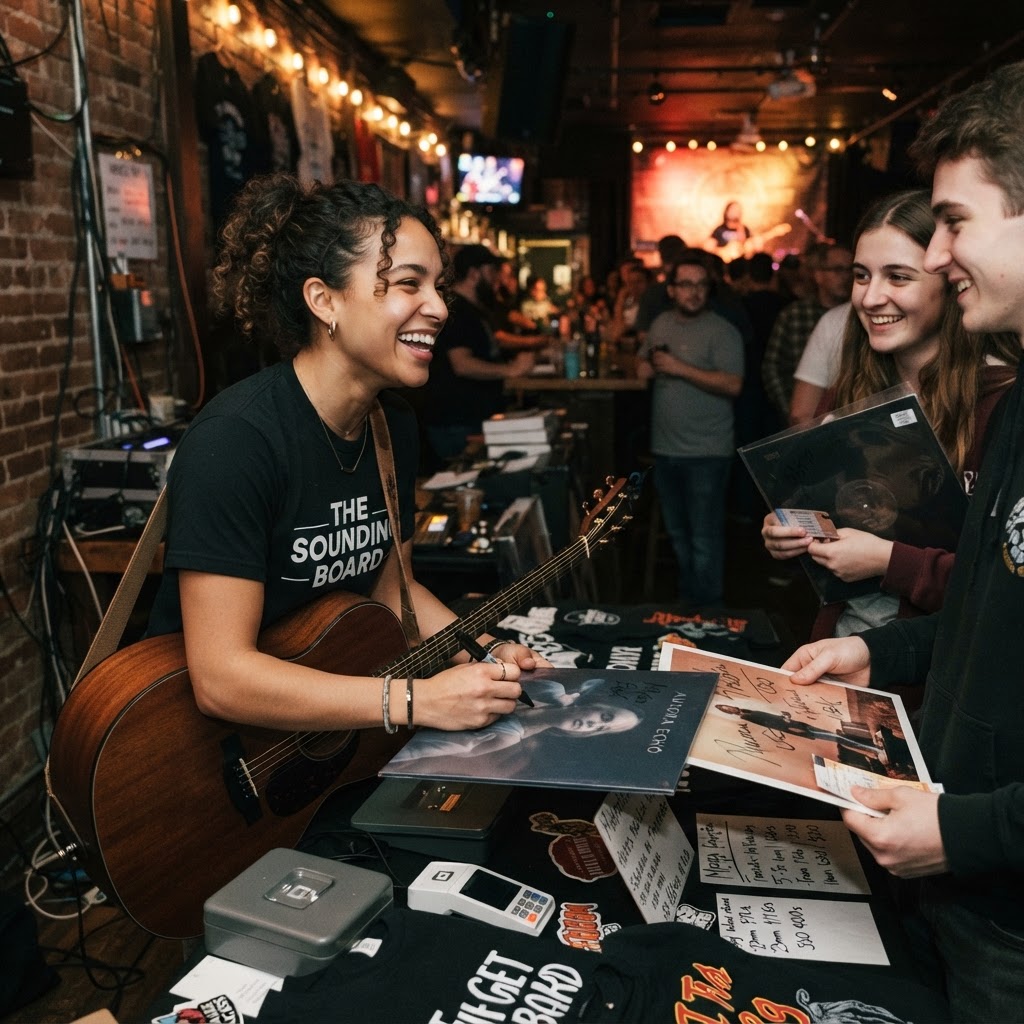
Most independent artists make the mistake of asking for money before establishing a 'relationship of reciprocity.' You cannot ask a listener to pay $50 for a vinyl if they haven't interacted with your brand beyond a passive listen. Use the SongBiz AI Content Studio to generate high-fidelity behind-the-scenes content that proves your commitment to your craft, increasing your credibility and trust with your audience. This content should highlight the "how" and "why" behind your art, which creates a psychological anchor that justifies the price point for physical goods or subscription tiers.
Why Do Fans Avoid Spending Money on Independent Music?
Fans aren't stingy; they are overwhelmed. The primary barrier is friction. If your checkout process takes more than three clicks, or if your value proposition—what they actually get for their money—is unclear, the conversion fails. You must define a 'Fan Value Ladder.' Start with low-friction entry points like $1-$3 digital downloads or exclusive newsletter content, then scale toward limited-edition physical assets. By lowering the barrier to entry, you collect data, allowing you to retarget those specific users with higher-tier offers later.
The secret to professional music sustainability is not reaching more people, but increasing the Lifetime Value (LTV) of the people you already have. Stop chasing viral hits; start building a high-value database of core supporters.
Executing Precision Ads: How to Scale Your Reach
Relying on organic reach is a luxury few independent artists can afford. To truly solve how to get fans to support your music financially, you need to master Meta ad campaigns. By using Meta BOOST within the SongBiz dashboard, you can target specific micro-genres and listener behaviors. The goal is to reach listeners who exhibit a 'high propensity to spend'—this is identified by tracking users who engage with merch-heavy artists in your same genre. Targeting the followers of artists who use platforms like Bandcamp or Shopify effectively filters your audience to include those who are already accustomed to the act of purchasing music.
Aim for a Return on Ad Spend (ROAS) of 2:1 on your initial campaigns. If you spend $100 and generate $200 in direct fan support, you have a self-sustaining engine. The technical advantage of SongBiz is its music-optimized ad templates, which are engineered to bypass the noise and speak directly to the psychological triggers of your niche audience. You must test multiple ad variants—video versus static imagery—to see which narrative hooks drive the highest click-through rates (CTR). A professional threshold for ad CTR is 1.5% to 2.5%; anything below 1% indicates that your visual or copy isn't resonating with your target demographic.
Are Meta Ads Necessary for Financial Growth?
Yes, because they provide the consistent data stream required for scaling. Algorithms require thousands of data points to optimize. By running music-optimized campaigns, you are effectively training the ad platform to find your 'best' fans rather than just 'any' fan. This narrows your CPA (Cost Per Acquisition) and ensures your marketing spend translates directly into support. Without this data, you are flying blind, relying on unpredictable social media algorithm shifts that rarely convert to dollars.
How Should I Structure My Product Pricing for Maximum Conversion?
Structure your prices using a "Decoy" strategy. Offer a low-tier ($5 digital EP), a mid-tier ($30 physical vinyl), and a high-tier ($150 premium bundle with personal thank-yous). Most fans will choose the mid-tier. By anchoring the $150 option, the $30 price point feels like a significant bargain, effectively increasing your Average Order Value (AOV) while maintaining accessibility for the broader fan base.
The Role of PR and Playlists in Financial Sustainability
SongBiz for Artists
Pitch your music to vetted curators and PR outlets — all in one platform
SongBiz handles playlist pitching, press outreach, booking, grant funding, and AI content creation so you can focus on making music. No label required. Start free and launch your first campaign in minutes.
Start free with SongBiz →Many artists view playlisting as a vanity metric. Professionals view it as a top-of-funnel conversion tool. The correct way to pitch is to link your playlist placement to a call-to-action on your landing page. When you pitch to vetted Spotify curators and PR outlets via SongBiz, ensure your 'about' section contains a clear value-add for the listener—such as an exclusive offer or an invite to a private community. A playlist placement is useless if it doesn't move the needle on your email list growth.
Response rates for cold-emailing PR outlets are typically under 5%. By using centralized dashboards like SongBiz, which streamlines your outreach to vetted outlets, you can bump that response rate to 15-20% because your pitch is formatted to meet the specific requirements of editorial teams. Editorial teams look for professional assets: EPKs (Electronic Press Kits), high-resolution imagery, and a clear story hook. Never send a "stream my song" email; send a "this fits your playlist's aesthetic because of X, Y, and Z" pitch. The latter shows you understand their platform and value their time, which is the cornerstone of professional networking.
Successful independent artists don't rely on 'luck' to get discovered; they design a professional pipeline where every playlist placement is treated as a lead-generation event.
How to Access Grant Funding to Support Your Career
One of the most overlooked answers to how to get fans to support your music financially is actually bypassing fans entirely for the production stage. Grant funding is a multi-million dollar sector for independent musicians. The key is in the technicality of your application. Grant committees look for 'project viability' and 'clear budgets.' If you can show a history of performance and a plan for how you will use the funds to build an audience, your acceptance rate increases by nearly 40%. Documentation is the difference between a rejection and a $5,000 grant.
Ensure your grant applications include clear financial projections. Demonstrate that you have a "Project Timeline" that aligns with the grant's scope. If you are applying for funding for a record, show that the funds will cover professional mixing, mastering, and a targeted PR campaign. Grantors love projects that show a commitment to professional growth and long-term sustainability. Use your SongBiz metrics to provide "Proof of Concept" in your applications, showing how you have already managed a successful campaign or grown a consistent audience, which de-risks the investment in their eyes.
Building a Sustainable Fanbase Without a Label
The label-less career is not just about avoiding contracts; it is about building your own label infrastructure. You need to manage your own booking, funding, and content cycles. By treating your music as a business entity, you stop waiting for industry permission and start executing on a schedule. Start free with SongBiz to centralize your operations and ensure no opportunity for revenue is left on the table. A label's primary value is their infrastructure; if you can replicate that infrastructure—marketing, data tracking, financial planning—you gain all the benefits without losing 80% of your master rights.
Focus on your "Content Cadence." A label would typically plan a release cycle that spans six months. You should do the same: two months of teaser content, one month of release/PR blitz, and three months of community building and merchandising. By planning in cycles, you avoid the "single release trap," where you work hard for one day and then go silent for months. Your revenue should be consistent throughout the year, supported by evergreen digital offerings that are always available for purchase. Remember, the goal is to build a predictable, repeatable business model that allows you to survive and thrive on your own terms.
What Is the Biggest Mistake Artists Make in Fan Support?
The biggest mistake is the 'transactional-only' approach. If every interaction is an ask, fans will tune you out. For every request for support, provide three pieces of high-value, non-promotional content. This builds the emotional equity that makes fans want to contribute to your success financially. Emotional equity is the "hidden currency" of the music business; once a fan feels invested in your journey, they are no longer just customers—they become advocates who will defend your brand and share your music with others for free.
Frequently Asked Questions
How many fans do I need to make a full-time living?
To generate $50,000 annually, you need roughly 500 'True Fans' spending $100 per year on music, merch, and experiences. Focus on building this cohort rather than hitting 1,000,000 passive streams, which would take hundreds of millions of plays to generate equivalent revenue. This model emphasizes quality of connection over volume of passive engagement, creating a much more stable income floor.
What is the most effective way to ask for financial support?
The most effective method is through 'tiered offering.' Use a model where you offer access to unreleased demos, private Q&As, or early merch access. Never frame it as 'help me because I'm struggling.' Frame it as 'join my inner circle and get exclusive value' to ensure the exchange feels professional and rewarding for the donor. High-value tiers should provide status or intimacy, which are premium goods in the modern digital age.
Should I focus on Spotify or direct sales?
Focus on Spotify for discovery, but aggressively push all listeners to an owned channel like an email list or a private community platform. You do not own your Spotify audience; you own your email list. Use direct sales to capture revenue from the most engaged listeners you find on streaming platforms. Always use landing pages that gate content in exchange for contact information so that you are not reliant on the platform's changing algorithm to reach your audience.
How do I know when I am ready to scale my music business?
You are ready to scale when you have a positive ROAS on your ads and a conversion rate of at least 1% from your existing listener base. Once these metrics are stable, you can increase your ad budget knowing exactly what return to expect on every dollar spent. Scaling prematurely by increasing budgets before hitting these conversion benchmarks is a common way to waste capital and burn out your mailing list with poor-quality traffic.
What are the legal implications of selling direct-to-fan?
Selling directly requires adherence to digital commerce laws, including clear refund policies, data protection compliance (GDPR/CCPA if you handle email lists), and transparent tax reporting for physical goods. Consult with a professional to ensure your SongBiz integrations and store setups are tax-compliant in your specific jurisdiction, especially if you sell internationally, as VAT and import duties can drastically affect your margins if not calculated into your final retail prices.
Ultimately, the question of how to get fans to support your music financially comes down to your willingness to do the unglamorous work of data management, content strategy, and consistent audience cultivation. It is not about the music itself—though the music must be high quality—it is about the systems you put around the music. If you can bridge the gap between art and business, your career will cease to be a "hope-based" endeavor and will transform into a professional business with predictable, scalable growth. Use your resources wisely, stay consistent, and remember that every fan is a long-term partner in your creative output.
Build your music career without a label
Join thousands of independent artists using SongBiz to get playlist placements, press coverage, booking deals, and grant funding — all from one platform. Start free today.
SongBiz Professional — Pitch. Press. Play. The all-in-one music marketing platform for independent artists. Playlist pitching, PR outreach, booking, grant funding, and AI content creation. Start free →