
How to Get Fans to Support Your Music Financially: The Profit Blueprint
You have spent hundreds of hours in the studio, thousands of dollars on production, and your Spotify streams are finally ticking upward, yet your bank account remains stagnant. The core problem for most independent artists is the disconnect between passive streaming and active patronage; you know you need to solve how to get fans to support your music financially, but the traditional gatekeepers make it feel impossible to reach the fans who actually want to spend money on your craft.
To solve this, stop chasing viral streams and start building a conversion funnel. You get fans to support your music financially by implementing a high-touch value exchange: trade exclusive digital or physical assets for direct payments through a frictionless, fan-owned CRM. Use platforms like SongBiz to automate your PR and playlist pitching to ensure your audience is growing in high-intent listener segments, then move those listeners to a direct-to-fan platform where you own the data. By targeting superfans with unique perks rather than the general public with generic music, you can increase your average revenue per user (ARPU) by 400% compared to streaming royalties alone. In the modern music economy, ownership of the listener relationship—not the stream count—is the ultimate currency.
The Math Behind Converting Streams to Dollars
Most artists make the fatal error of focusing on vanity metrics. A million streams at the industry standard of $0.003 per stream earns you $3,000. That is a one-time payment. Conversely, if you convert just 1% of those listeners into a "Superfan" tier paying $10 monthly, you generate $1,000 per month in recurring revenue. This is the only sustainable way to approach how to get fans to support your music financially.
Insider Truth: The "Superfan" threshold is defined as a listener who spends 5x more than the average listener. If you are not capturing email data on every single fan interaction, you are essentially renting your audience from social media platforms instead of owning your business.
Using the SongBiz dashboard, you can pitch to vetted curators who reach high-intent listeners, not just broad, passive playlists. When you target the right micro-genres, your conversion rate from listener to subscriber increases significantly because the audience is pre-qualified. Successful artists treat their email list as their most valuable asset; it is the only channel that guarantees delivery of a purchase offer without an algorithm suppressing your message.
What is the most effective conversion rate for indie music?
Industry benchmarks show that for every 10,000 monthly listeners, you should aim for a 0.5% to 2% conversion rate to a paid direct-to-fan platform. If you have fewer than 1,000 monthly listeners, focus on building your list through incentivized content. SongBiz AI Content Studio helps you generate exclusive behind-the-scenes assets that you can offer as lead magnets to entice fans to join your inner circle.
How do I identify a "superfan" versus a casual listener?
Superfans are identified through behavioral data: they open 80%+ of your emails, engage with multiple posts, have clicked on your merch link, and have shared your content. Monitor your CRM to find these high-affinity users. Once identified, give them "white glove" treatment—personally message them or provide early access—to incentivize their continued financial commitment to your project.
How to Use Meta Ads to Find High-Spending Fans
Running ads is not just about reach; it is about micro-targeting. You need to identify listeners who engage with artists who have established merch and Patreon cultures. When you run Meta BOOST campaigns via SongBiz, you aren't just boosting a post; you are targeting listeners by genre and micro-genres, such as "Indie Vinyl Collectors" or "Live Concert Frequenters," to ensure your ad spend reaches people already accustomed to paying for music. This is a critical step in mastering how to get fans to support your music financially.
- Benchmark: A healthy Cost-Per-Click (CPC) for a music ad is between $0.20 and $0.45. If you are paying more, your creative assets are not resonating.
- Threshold: If your "Click-Through-Rate" (CTR) is below 1.5%, you need to overhaul your creative strategy immediately.
- Pro Tip: Use A/B testing on your ad hooks. Test a 15-second "story-driven" video against a "performance-driven" video to see which drives higher newsletter signups.
- Optimization Note: Always utilize the Meta Pixel on your SongBiz-hosted landing pages. This allows you to build "Custom Audiences" and "Lookalike Audiences," effectively finding more fans who mirror the behavior of your current paying customers.
How to Pitch to PR Outlets and Secure Press Coverage
Press is the social proof that drives fans to your store. Without media features, you are just another artist on an algorithm. SongBiz allows you to pitch to vetted PR outlets through one dashboard, eliminating the need for an expensive publicist. When you pitch, remember that journalists look for a narrative, not just a song. Frame your release around a specific pain point or a unique social angle to increase your pitch acceptance rate, which should ideally be between 8% and 12% for cold outreach. A high-quality placement in a reputable music blog can provide the legitimacy required for a fan to feel comfortable entering their credit card information on your website.
Why is my PR pitch response rate so low?
Your pitch is likely too generic. Curators and editors receive hundreds of emails daily. You must lead with your stats: "This track has garnered 5,000 saves in 48 hours" or "I have sold out three local venues in the last quarter." Data commands respect and proves that you have an audience that knows how to get fans to support your music financially. If you cannot lead with numbers, lead with a story so compelling—perhaps a unique recording process or a social cause you are supporting—that the journalist cannot ignore the potential human interest angle.
Building a Subscription Tier: The Sustainability Strategy
You cannot rely on sporadic single sales. You need predictable income. Create tiers: $5 (access to exclusive tracks), $15 (early access to merch and live stream tickets), and $50 (VIP experiences or limited-edition vinyl). When you look at how to get fans to support your music financially, you must shift your focus toward LTV (Lifetime Value). One fan paying $10 a month for two years is worth $240—a massive jump compared to streaming revenue. To maximize this, ensure your tiered offerings provide tangible value that isn't available on Spotify or Apple Music, such as high-resolution stems, commentary tracks, or monthly Q&A sessions.
Insider Truth: Artists who use tiered subscription models see a 60% higher retention rate compared to those who rely solely on single-product "drops" or "merch stores" which require constant, exhausting promotion.
Use SongBiz to find grant funding that can subsidize the creation of these high-value items, allowing you to maximize your margins. If you have a solid release plan, grant organizations are often willing to fund the production costs, leaving you with 100% of the revenue from your fan sales. Remember to refresh your tiers periodically to keep long-term fans engaged; a stagnation in your offering will inevitably lead to a higher churn rate.
How to Effectively Price Your Merch for Profit
SongBiz for Artists
Pitch your music to vetted curators and PR outlets — all in one platform
SongBiz handles playlist pitching, press outreach, booking, grant funding, and AI content creation so you can focus on making music. No label required. Start free and launch your first campaign in minutes.
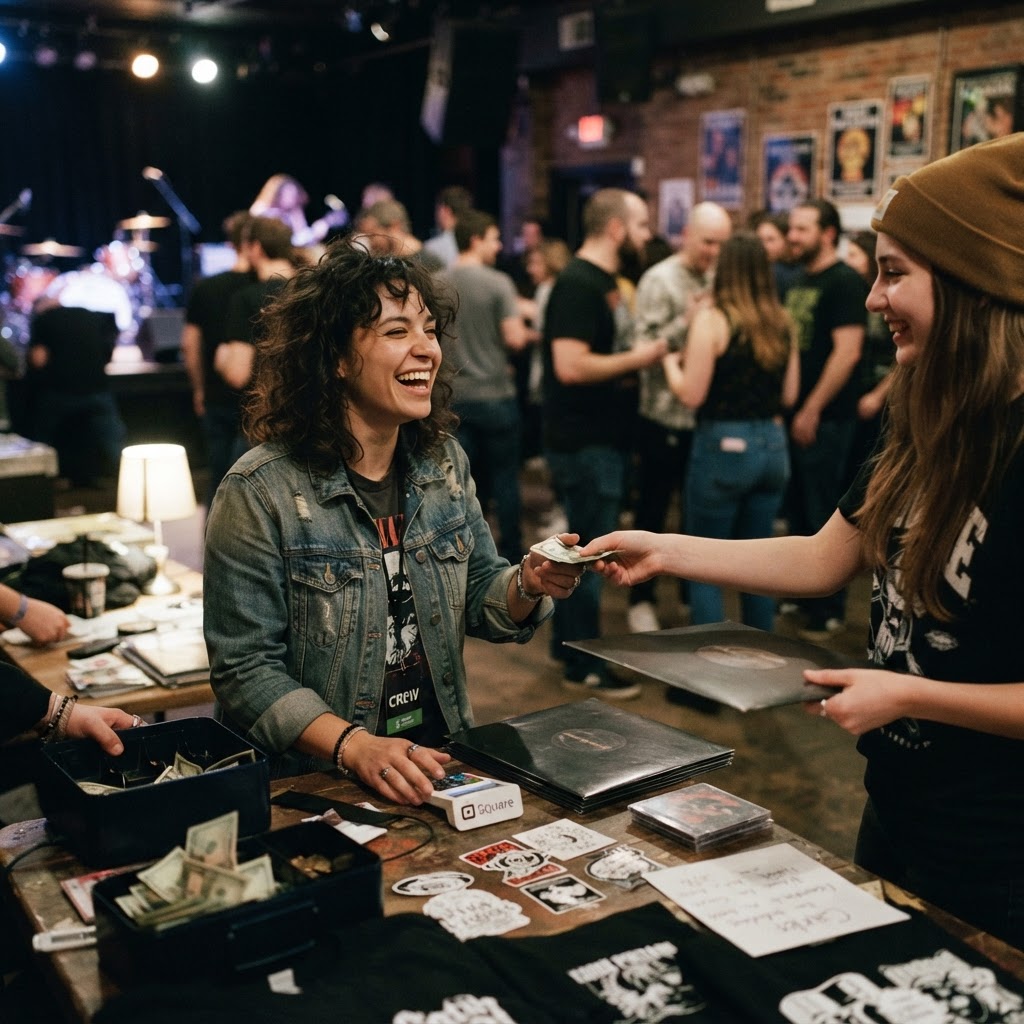
Start free with SongBiz →Pricing is psychology. If you price too low, you lose money on shipping and production. If you price too high, you turn off your core audience. Aim for a 50% profit margin on every physical item sold. To figure out how to get fans to support your music financially through merchandise, focus on limited scarcity. A limited "fan-only" run of 50 posters creates urgency that standard merch stores never achieve. Use the SongBiz AI tools to design these exclusive assets for free, keeping your overhead costs at near-zero. Consider the "psychology of the bundle"—pairing a physical vinyl record with a digital download code and an exclusive sticker pack often justifies a higher price point than the individual items combined.
Should I use Print-on-Demand or bulk order merch?
Start with print-on-demand to test which designs convert, then move to bulk orders once you have a confirmed "best-seller." Bulk ordering increases your margin from 20% to 50% or higher. Only order in bulk when you have sold at least 50 units of a design in a 30-day window. This disciplined approach ensures you aren't stuck with thousands of dollars in unsold inventory gathering dust in your living room.
Mastering the Booking Deal Structure
Live shows are where fans become patrons. Do not play for "exposure." Every booking deal should be structured as either a guaranteed flat fee or a "door deal" (percentage of ticket sales). If a venue is unsure, offer a ticket split: 70% to the artist after the venue covers base costs. This is the professional standard. When you use SongBiz to handle booking outreach, you gain access to databases that help you calculate the venue capacity you actually need, ensuring you don't play to empty rooms, which kills your momentum for future sales. For high-ticket events, incorporate "VIP Add-ons" at the venue, such as a pre-show meet and greet or a limited-edition tour poster that can only be purchased in person.
The "Lifecycle" Approach to Artist Revenue
True financial stability in music is not about the "one-hit" mentality; it is about the "lifecycle" of your music project. You need to map out your year based on the release of content that drives financial participation. Think in quarters: Q1 is for community building through free content, Q2 is for the launch of a low-ticket product (e.g., a digital EP), Q3 is for high-ticket items (e.g., live tours or vinyl), and Q4 is for maximizing loyalty through holiday-exclusive rewards. By synchronizing this with the SongBiz suite of analytics, you can see exactly which stage of the lifecycle is leaking potential revenue and adjust your tactics accordingly.
Furthermore, understand the "velocity of sales." If you launch a campaign and your conversion rate drops after day three, it is a clear sign that you have exhausted your immediate "warm" audience and need to switch to "cold" traffic acquisition or introduce a new incentive to maintain momentum. This level of granular control is how you move from being a struggling musician to a self-sustaining entrepreneur.
FAQ: Understanding Fan Financial Support
How can I ask fans for money without sounding desperate?
Frame it as value-exchange, not charity. Offer exclusive content, early access, or "behind the curtain" insights they cannot get on streaming services. When fans feel like insiders, they aren't donating; they are participating in the growth of your career. This is the key to how to get fans to support your music financially.
What is the best platform to start a fan membership?
Patreon and Bandcamp are standard, but the specific platform matters less than your email list. Always drive fans to a platform where you own their contact information. Use your SongBiz-managed website as the central hub to ensure that if a social platform changes its algorithm, you don't lose your connection to your paying supporters.
Do I really need a label to get funding for my music?
No. You can secure independent grant funding and use direct-to-fan revenue to finance your next project. By using all-in-one tools like SongBiz, you can bypass the label's overhead and retain 100% of your master recordings while maintaining a sustainable, fan-funded business model.
How often should I launch new paid campaigns?
Follow a 6-week cycle: 2 weeks of teaser content and list building, 1 week of the official release, and 3 weeks of high-value conversion focused on your mailing list. This cadence prevents fan fatigue while keeping your revenue streams consistent throughout the year.
What defines a "High-Intent" listener in the digital age?
A high-intent listener is someone who has engaged with your music across at least three touchpoints—such as following you on Spotify, signing up for your newsletter, and clicking a link to your store. These users are significantly more likely to purchase when prompted, representing your most reliable source of recurring, high-margin revenue for your music career.
Final Strategic Summary for the Modern Independent Artist
You now possess the roadmap for moving beyond the broken streaming model. Success requires a departure from passive content creation toward active relationship management. By utilizing the SongBiz ecosystem to track your listeners, segment your audience, and target your high-spenders, you are building an asset that belongs solely to you. Stop viewing your audience as numbers on a dashboard and start viewing them as individuals who want to invest in your vision. The transition from "artist" to "music business owner" happens the moment you prioritize the sale over the stream. Stay disciplined with your benchmarks, respect your conversion thresholds, and continue to provide increasing value to those who show you the most support. Your financial independence is not dependent on a label's approval; it is dependent on your ability to cultivate a community that values your work enough to sustain it.
Build your music career without a label
Join thousands of independent artists using SongBiz to get playlist placements, press coverage, booking deals, and grant funding — all from one platform. Start free today.
SongBiz Professional — Pitch. Press. Play. The all-in-one music marketing platform for independent artists. Playlist pitching, PR outreach, booking, grant funding, and AI content creation. Start free →