
How to Sell Merch as an Independent Artist: The Profit Roadmap
You have spent months perfecting your latest EP, yet your bank account remains stagnant. You feel the crushing frustration of high stream counts that yield zero tangible income, leaving you wondering how to sell merch as an independent artist without a label backing or a massive upfront investment. The truth is, streaming is a discovery mechanism, not a revenue engine. To survive, you must transform your casual listeners into high-value customers through a strategic physical and digital goods funnel.
To sell merch effectively, focus on high-margin, low-inventory items like stickers or limited-edition apparel, integrate direct-to-fan links within your Spotify artist profile, and utilize Meta ad campaigns to target your top 5% of listeners who have already saved your music.
Understanding the Psychology of Fan Conversion
The biggest mistake artists make when asking how to sell merch as an independent artist is treating merchandise like a utility instead of an identity. Fans buy your hoodie because it signals membership in your "tribe," not because they need a garment. Data shows that artists who convert 1% to 3% of their monthly listeners into buyers are performing at industry-standard levels. If you have 10,000 monthly listeners, you should be moving 100 to 300 units per collection launch. If your conversion rate is below 0.5%, your issue is not the design; it is the relationship.
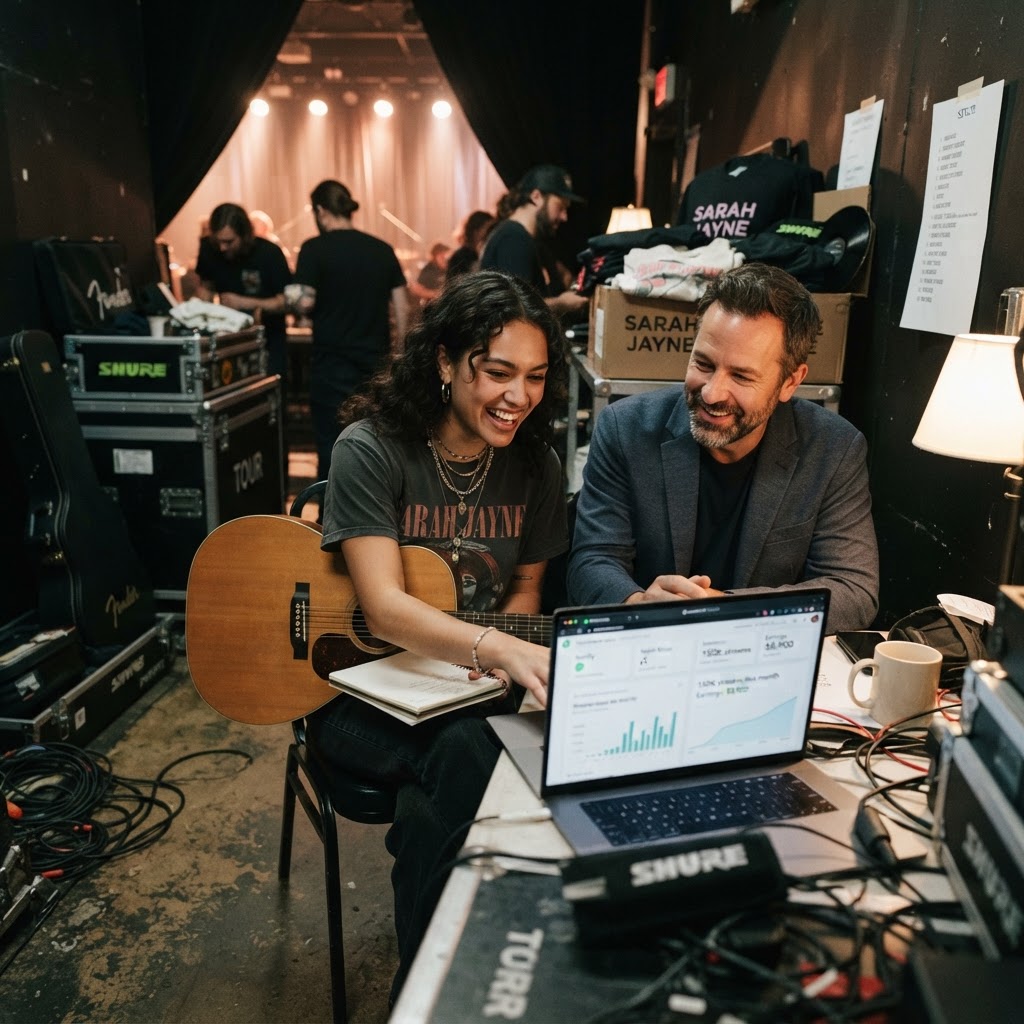
Leverage the SongBiz AI Content Studio to generate high-conversion lifestyle assets—mockups that show your designs in real-world environments. When fans see an artist "wearing" the vision, they aren't buying a t-shirt; they are buying the aesthetic identity you have cultivated. Use these assets to drive traffic directly to your own store, avoiding the marketplace fees that eat into your margins. Authenticity in your marketing collateral is the difference between a "product" and "art merchandise." A fan who perceives your store as a gallery of your brand will always outspend a fan who views it as a basic retail site.
Pro Tip: Never drop more than three designs at once. A limited choice increases conversion rates by reducing analysis paralysis. When fans see too many options, they hesitate. Keep it lean to maximize your sell-through.
How to sell merch as an independent artist using Meta ads?
You cannot rely on organic social reach alone. The algorithm penalizes external links, meaning your store link in your bio is getting suppressed. To scale, you must utilize paid acquisition. Use Meta BOOST on SongBiz to target "lookalike" audiences based on your existing fan data. Focus your ad spend on users who have already engaged with your music on Spotify. When you target people who have a high "save" count on your tracks, your cost-per-purchase (CPP) typically drops by 40% compared to broad-audience targeting.
Set your daily budget at a testing threshold of $5 to $10 per day. Run the campaign for 72 hours. If the conversion rate is above 2%, scale the budget. If it is below 1%, rotate your creative. SongBiz provides the tools to manage these music-optimized campaigns, ensuring you aren't burning cash on audiences that don't care about your sound. Remember, you are tracking the "Pixel" conversion data. Ensure your website has the Meta Pixel installed so you can implement retargeting sequences; 70% of your total sales will likely come from customers who visited your site at least twice before finally committing to the purchase.
How to sell merch as an independent artist at live shows?
Live performances remain the highest-converting funnel for merch sales. The goal is to make the table a central part of the experience, not an afterthought in the back of the room. Aim for a "per-head" (PH) metric of $2.00 to $5.00—that is, every person in the room should generate that much in merch revenue on average. If your venue holds 200 people, you should aim to walk away with $400–$1000 in merch sales. To hit these benchmarks, your physical presence must mirror your online aesthetic.
Use these tactics to boost that PH number:
- Keep the merch table well-lit; if it is dark, fans will walk past it. Use portable LED bars if the venue lighting is poor.
- Offer a "show exclusive" item that isn't available online, creating immediate scarcity. A simple screen-printed poster with the specific city and date adds high perceived value for a low production cost.
- Use QR codes at the booth to offer an instant digital download or a "secret" track that unlocks when they buy a physical item.
- Always accept digital payments via a dedicated card reader; cash-only booths see a 30% lower conversion rate.
- Train your support acts or merch staff to actively engage with fans. A "soft sell" approach—asking "Which track was your favorite tonight?"—builds rapport before mentioning the apparel.
What are the most profitable items to sell for indie musicians?
When learning how to sell merch as an independent artist, focus on items with the highest profit margins. T-shirts are the industry standard, but the overhead can be high. High-margin items include enamel pins, high-quality stickers, and digital bundles like stems or behind-the-scenes video content. These items have a 70% to 80% profit margin, whereas apparel often hovers around 30% to 40% after printing and shipping costs.
Consider a "Pre-Order" model for high-cost items. By gauging interest through a landing page before ordering inventory, you remove the financial risk of holding dead stock. This is essential for independent artists who lack deep capital reserves. Use the SongBiz dashboard to track which of your tracks have the highest "Save" rates; those are the listeners you should email first about pre-orders. When you move from "bulk buying" to "just-in-time" inventory, you increase your liquidity and free up capital to spend on high-ROI activities like email list growth.
How to manage inventory and fulfillment as a DIY artist?
Logistics often kill the spirit of the independent artist. If you are spending five hours a week packaging orders, you are not spending five hours writing songs or pitching to curators. Use Print-on-Demand (POD) for high-volume basics and keep your "special" items as limited-run screen-printed batches. This hybrid model allows you to maintain quality for superfans while ensuring you never run out of entry-level stock for new fans.
It is vital to maintain a "Safety Stock" threshold. If your average sales velocity is 10 hoodies a month, you should always have at least 15 in reserve. Automating inventory alerts via your website platform ensures you don't miss sales due to stock-outs. Neglected fulfillment is a primary reason for low fan retention; if a customer waits three weeks for a shipping notification, they are significantly less likely to engage with your next release or purchase from future drops.
Success Threshold: If you are doing more than 50 orders a month, you must automate. Outsourcing fulfillment to a specialized music-focused company pays for itself by giving you back the hours required for higher-level career tasks like grant applications or media outreach.
The Economics of Limited-Run Drops
SongBiz for Artists
Pitch your music to vetted curators and PR outlets — all in one platform
SongBiz handles playlist pitching, press outreach, booking, grant funding, and AI content creation so you can focus on making music. No label required. Start free and launch your first campaign in minutes.
Start free with SongBiz →The "drop" culture has fundamentally shifted how independent artists sell. Rather than keeping a static storefront with year-round inventory, successful artists utilize a cadence of releases—much like the fashion industry. A limited-run campaign creates an artificial deadline. When a fan knows a design will be gone in 72 hours, the urgency to buy spikes. This "FOMO" (fear of missing out) is your greatest psychological lever.
Align these drops with your music release schedule. For instance, if you are releasing an EP, launch a matching "concept capsule" one week before the release. This keeps your brand top-of-mind. Use SongBiz analytics to monitor engagement spikes; when a song starts gaining traction on a major playlist, that is your signal to initiate a drop. By connecting your merch sales cycle directly to your listener growth cycle, you create a self-sustaining momentum that keeps your revenue growing alongside your fanbase.
How to sell merch as an independent artist through digital distribution?
Your digital footprint is your virtual storefront. Ensure that your Spotify "Merch" section is populated via your distribution partner. Many artists forget that Spotify now allows direct merch integration. This is high-intent traffic; a listener viewing your profile is already a qualified lead. Keep this section updated with items that match your current release cycle—if you have a new single out, the merch should visually align with that single’s artwork.
SongBiz allows you to streamline your presence across all these channels. By unifying your playlist pitches, PR efforts, and merch funnel, you stop treating these as separate tasks and start viewing them as parts of an integrated ecosystem. This is how you reach a sustainable $2k to $5k monthly revenue milestone without a record label taking their cut. Success at this level requires rigorous testing of landing pages, A/B testing your checkout flows, and ensuring your mobile site is optimized for one-click purchases—especially for fans coming from TikTok or Instagram links.
Advanced Tactics: Building a Recurring Revenue Stream
To reach the upper echelons of independent success, stop viewing merch as a one-off transaction. Implement a "Fan Club" or Patreon tier that offers exclusive early access to merchandise drops. By charging a monthly subscription, you create a base level of income that covers your core production costs. These members are your "core 100"—the fans who will buy every single limited-edition item you produce. Focusing on their experience creates a halo effect that ripples out to your casual listener base, increasing their conversion potential over time.
Analyze your customer lifetime value (CLV). If your average customer buys once and never returns, your focus should be on post-purchase email flows. Send an automated "Thank You" email 14 days after their purchase with a unique discount code for their next item. This simple touchpoint can increase repeat customer rates by 15-20%. In the modern music industry, your email list is your most valuable asset; it is the only platform you truly own that is not subject to algorithmic changes or platform volatility.
FAQ: People Also Ask
How much should I charge for band merch to make a profit?
Use the 3x rule: calculate your landed cost (product plus shipping) and multiply by at least three. If your cost is $10, you must sell for $30. Anything lower will not cover the marketing costs or the labor required to manage your store, leaving you with little to reinvest into your next release.
When is the right time for an artist to start selling merch?
Start as soon as you have a "warm" audience of at least 500 monthly listeners. Before this, focus on building your fanbase through playlisting and PR. Use SongBiz to pitch to vetted curators and increase your reach; once you have consistent listener retention, launch a small batch of 20-30 limited-run items.
How can I sell more merch without being "salesy"?
Focus on storytelling rather than features. Don't post a picture of a shirt; post a video of you creating the art for it or explaining the meaning behind the design. People buy the artist, not the product. Align the merchandise with your brand's narrative to make the purchase feel like a contribution to your art.
What is the best way to handle merch inventory?
Adopt a hybrid strategy. Use Print-on-Demand for everyday items like t-shirts to eliminate inventory risk. Save physical, high-quality "collector" items like signed vinyl or limited-edition hoodies for tour dates or special digital drops. This keeps your cash flow positive while keeping your superfans excited for exclusive drops.
How do I integrate merch with my streaming presence?
You must link your store via your artist profile management tools (like Spotify for Artists). This allows your items to appear directly on your profile. By syncing your merch with your latest release artwork, you create a cohesive visual narrative that validates the listener's journey from a casual streamer to an invested, paying supporter of your musical project.
Closing Thoughts on Scaling Your Merch Brand
The journey from selling your first sticker to scaling a professional apparel line is a marathon, not a sprint. Consistency is the primary factor that differentiates hobbyists from professionals. Treat your store like a startup: analyze the data, pivot when necessary, and never underestimate the power of high-quality visuals. By following the SongBiz profit roadmap, you ensure that every stream you generate is a potential path to a tangible sale. Your music is the product; your merchandise is the brand. Invest in both with equal intensity to achieve true artistic and financial independence.
Build your music career without a label
Join thousands of independent artists using SongBiz to get playlist placements, press coverage, booking deals, and grant funding — all from one platform. Start free today.
SongBiz Professional — Pitch. Press. Play. The all-in-one music marketing platform for independent artists. Playlist pitching, PR outreach, booking, grant funding, and AI content creation. Start free →