How to Tour as an Independent Musician: The Profitability Guide
You have spent thousands of dollars recording, months polishing your production, and yet you are staring at a calendar with zero dates, wondering how to tour as an independent musician without losing your life savings. The crushing reality of the modern music business is that most independent artists treat touring as a marketing expense rather than a revenue-generating business model. If you are tired of playing to empty rooms or, worse, paying for the privilege of performing, this guide will change your trajectory.
To tour successfully as an independent musician, you must pivot from 'booking gigs' to 'routing markets.' Prioritize high-density geographic regions where your Spotify data proves you have listeners, secure performance guarantees by leveraging your digital conversion rates as leverage, and utilize platforms like SongBiz to automate your PR and playlisting months before you step foot in a city.
Data-Driven Routing: How to Tour as an Independent Musician Profitably
The most common mistake independent artists make is 'touring in a vacuum.' They book a show in a city because it looks cool, not because there is existing demand. You need to stop guessing and start calculating. Before you email a single talent buyer, log into your streaming analytics. You are looking for a listener density threshold. Unless you have at least 500-1,000 monthly listeners in a 50-mile radius of a city, the cost of gas, van rental, and lodging will almost always exceed your door split. Use the SongBiz dashboard to cross-reference your streaming data with local press outlets to see if you can build a localized media campaign to bridge the gap.
Sophisticated routing requires a 'cluster strategy.' Do not drive six hours for a single show. Build a regional loop of at least 3-4 shows within a 200-mile radius. This minimizes fuel consumption, which is often the silent killer of independent tour budgets. When you analyze your data, look at your 'Top Cities' list in Spotify for Artists. If you have a cluster of three cities—for example, Seattle, Portland, and Eugene—you have a viable 'Pacific Northwest' run. This cluster strategy allows you to consolidate your marketing efforts and press outreach, making you a more attractive prospect for venues in those specific cities.
How Do I Find Venues That Actually Book Independent Acts?
Stop emailing 'info@' addresses at mid-sized clubs. These emails go directly into a black hole. Successful touring artists identify the 'entry-level' tier of venues—those with a 150-300 capacity. These venues operate on a 'door-deal' or 'guarantee vs. percentage' model. Your pitch must be professional. Include a one-sheet featuring your Spotify monthly listener count, a link to your best press coverage, and a clear, concise request. If you are struggling with professional outreach, leverage SongBiz to streamline your PR and playlist pitching, giving you the social proof necessary to convince talent buyers you are a low-risk, high-reward investment.
When researching, visit venue websites and check their 'tech specs' and 'booking' pages specifically. If a venue lists a specific talent buyer’s name, that is your primary contact. If they don't, search LinkedIn for '[Venue Name] Talent Buyer' or '[Venue Name] Booking Manager.' Finding a human name increases your open rate by approximately 40%. Once you have the contact, keep your initial outreach to three sentences: Who you are, the data proof of your audience in their city, and the dates you are requesting. If they don't reply within one week, send a single, polite follow-up. If there is no response after the follow-up, move on. Persistence is good; pestering is detrimental to your reputation.
The Math of the Tour: Calculating Your Break-Even Point
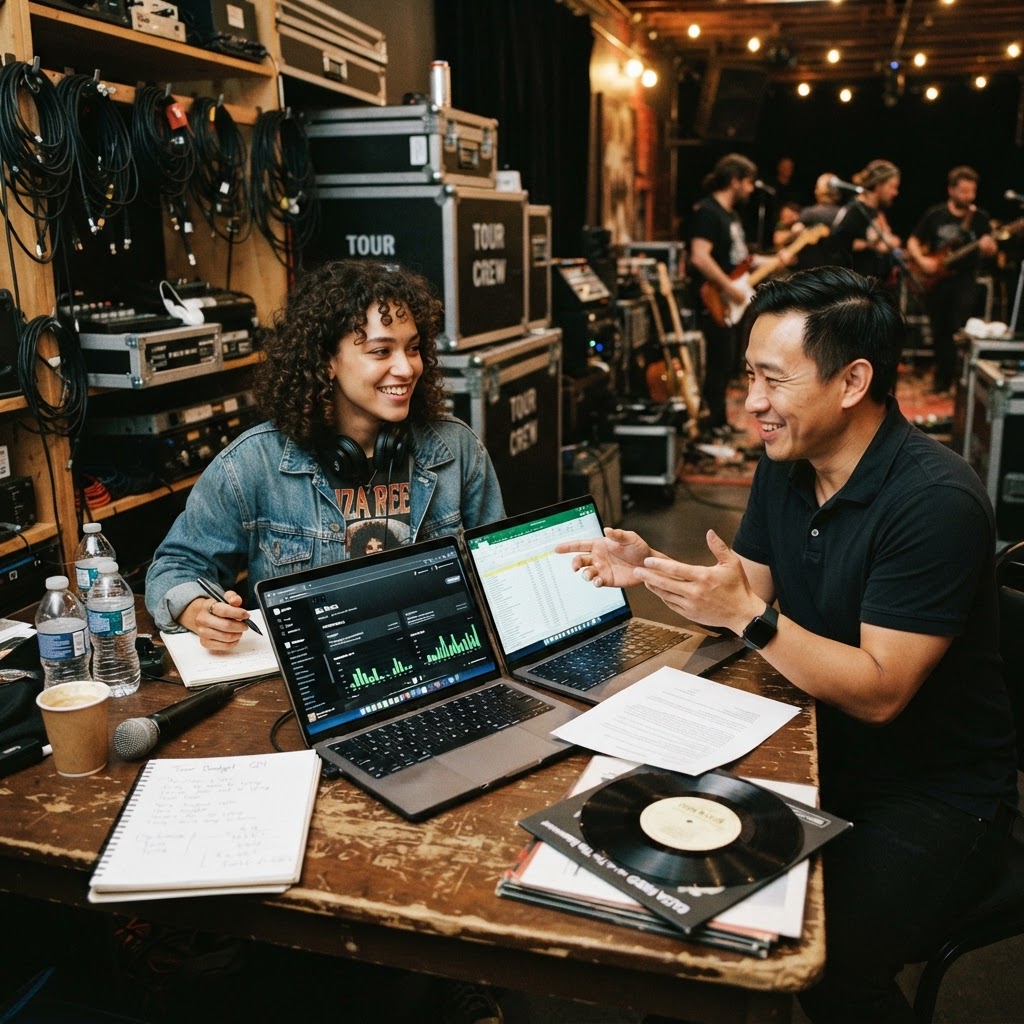
If you don't track your numbers, you aren't an artist; you are a hobbyist. To learn how to tour as an independent musician, you must create a granular spreadsheet. Your budget should include: fuel (at current market rates), lodging (Airbnb or budget hotels), per diems (don't skip this—it's your food cost), and marketing. The 'golden rule' for independent touring is the 60% rule: your total expenses should never exceed 60% of your projected revenue from ticket sales and merch. If the math doesn't work, stay home and use your budget to run Meta ad campaigns via SongBiz to grow your audience in target cities until the math does work.
Benchmark your 'per-cap' (revenue per attendee). If you perform for 50 people and your tickets are $15, you have $750 in gross revenue. After the venue takes their 20% cut for sound and door staff, you have $600. If your merch conversion rate is 15%, you will sell roughly 7-8 items. If your average merch price is $25, that is an additional $200. Your total 'nightly nut' is now $800. If your daily operating expense (van, gas, food, hotel) is $450, you have netted $350. This is how you build a scalable business. If your expenses are higher than this, you must either increase your draw or decrease your logistics costs (e.g., sleeping in the van or staying with fans/friends).
Insider Truth: The most successful independent tours don't rely on ticket sales for profit—they rely on 'attach rates.' If 10% of your total room capacity buys a $25 vinyl record or a $30 t-shirt, you have effectively doubled your revenue per head. Build your setlist to peak at your merch table. Place your merch table in the direct path of the exit, ideally near the bar, so patrons are incentivized to stop while waiting for their last drink.
Leveraging Tech to Pre-Sell Your Tour
You cannot 'arrive' in a city and expect people to show up. You must manufacture demand. This is where professional independent artists use AI-powered tools. Use the SongBiz AI Content Studio to generate high-converting short-form video assets that target your specific audience in the cities you are routing. By running Meta BOOST ads optimized for your genre, you can target listeners in your upcoming tour stops. If you can prove to a venue that you are spending $200 on ads to drive ticket sales in their local market, you have leverage to negotiate a higher guarantee. This is how you change the booking dynamic from 'begging for a slot' to 'partnering for a sell-out.'
Digital conversion metrics are the new currency of the touring circuit. When you email a promoter, attach a screenshot of your Meta Ad Manager showing that your ads in their zip code are driving click-through rates (CTR) above 2%. A promoter who sees that you are actively spending your own money to fill their room is a promoter who will book you again. They are not just booking a musician; they are booking a partner who understands the economics of the live music ecosystem. SongBiz provides the necessary analytics to make this case, essentially acting as your outsourced booking agency’s data arm.
What Are The Best Tools for Booking Shows Independently?
Beyond standard booking, you need a centralized hub to handle the logistics. SongBiz allows you to manage your PR and outreach, ensuring that by the time your tour dates are announced, you have press coverage in those specific cities. This creates a feedback loop: press coverage leads to playlist adds, which leads to higher streaming numbers, which leads to better venues booking you at higher guarantees. It is a flywheel effect that separates the top 1% of independent acts from the rest.
Furthermore, use digital calendaring tools to keep your tour logistics transparent. Software that tracks mileage, parking restrictions, and load-in times can save you from costly fines or schedule slips. When you are on the road, time is money. Every hour you spend trying to find a load-in door or a place to park a trailer is an hour you aren't spending on social media engagement, which is critical for driving walk-up traffic the night of the show.
How do I use localized PR to sell more tickets?
Focus on 'hyper-local' media. Instead of aiming for national blogs, pitch your show to city-specific weeklies, college radio station blogs, and local music influencers. When pitching, lead with the 'hook' of the event—not just your music, but your connection to the city. If you use SongBiz to secure even three local features, you create the 'social proof' necessary to convince local listeners that your show is the 'event' to attend.
Grant Funding and Financial Sustainability
Many artists wonder how to tour as an independent musician when they lack the upfront capital. The answer is arts grants and private funding. Most artists ignore these because the application process is daunting. However, professional independent artists treat grant writing as a core business skill. Look for regional arts council grants specifically designed for 'touring support' or 'market development.' When applying, frame your tour not as 'playing shows' but as 'professional development and audience cultivation.' Using platforms like SongBiz to organize your career milestones makes the documentation phase of grant applications significantly faster.
When preparing your budget for grant applications, emphasize the 'economic multiplier' effect. Mention how your tour will stimulate local economies (spending money at local diners, gas stations, hotels, and hiring local sound engineers). Many arts organizations are specifically looking for applicants who understand that touring is a community engagement initiative. Keep detailed logs of your expenses; grant auditors require meticulous receipts. A grant-funded tour is essentially 'risk-free capital,' which allows you to perform in secondary markets that might not be immediately profitable but are essential for long-term brand building.
The Psychology of the Curator and the Promoter
SongBiz for Artists
Pitch your music to vetted curators and PR outlets — all in one platform
SongBiz handles playlist pitching, press outreach, booking, grant funding, and AI content creation so you can focus on making music. No label required. Start free and launch your first campaign in minutes.
Start free with SongBiz →Understanding the 'gatekeeper' mindset is essential. A Spotify curator cares about save rates and skip rates. A talent buyer cares about ticket sales and bar spend. You are a 'product' to them. When you pitch, talk about your audience, not your music. If you can say, 'I have 1,200 active listeners in the Denver area, and my latest release had a 15% save rate,' you are speaking their language. Use your data to build credibility. Never send a 'cold' pitch without providing data points that prove your value. This is how you move from the 'local support' slot to the 'headliner' slot.
Remember that the promoter is constantly worried about the 'empty room.' The greatest fear a talent buyer has is a Tuesday night where they are paying security, sound techs, and bartenders to work for an audience of five people. By offering a 'no-risk' pitch—e.g., 'I will cover the support slot's fee' or 'I will share my entire mailing list of 500 local fans for the show announcement'—you alleviate that anxiety. You are essentially offering to act as an extension of their marketing department. In the modern music industry, the musician who brings the audience is the musician who stays booked.
Pro Tip: Always ask for the 'bar report' after your set. If you know exactly how much alcohol was sold during your performance, you can use that data to demand a higher pay percentage for your next booking at that same venue. If your audience specifically drinks craft beer or top-shelf spirits, highlight this in your next negotiation to prove your fans' high purchasing power.
Strategic Networking: Building a Touring Ecosystem
Beyond the direct booking of venues, you must build a touring network of peer artists. The most efficient way to tour is to swap support slots. Find an artist of a similar size in a city you want to visit. Offer them a slot in your home city in exchange for a slot in theirs. This 'mutual support' model reduces the barrier to entry for both parties. You aren't just selling your tickets; you are tapping into their established fanbase. Use SongBiz to identify artists who share your listener profile, then use the platform’s contact tools to initiate these cross-promotional partnerships.
Don't overlook the importance of local radio in your touring plan. College stations and independent FM stations often have high loyalty among listeners. Reaching out to a local station manager two weeks before you arrive can lead to an on-air interview or a live acoustic set. This level of exposure is often worth far more than a paid social media ad. Ensure your SongBiz electronic press kit (EPK) contains high-quality broadcast-ready assets to facilitate these appearances easily.
5 Actionable Steps to Launch Your Tour
- Filter by Data: Use Spotify for Artists to find your top 5 cities outside of your home market. Prioritize cities where your 'monthly listeners' are growing at the fastest rate (the 'velocity' metric).
- Validate Demand: Spend $100 on a geo-targeted Meta ad campaign to see if your 'engaged listener' audience matches your target tour stops. If you can't generate interest for $100, you aren't ready to sell tickets.
- Build the Pitch: Create a one-page EPK that highlights your listener growth, your press mentions, and a link to your best live video. Keep it under 2MB so it doesn't trigger spam filters.
- Pitch the Gatekeepers: Send personalized emails to talent buyers at 150-300 cap venues 3-4 months before your intended dates. Focus your email on their business needs, not your creative ego.
- Leverage SongBiz: Use the all-in-one dashboard to manage your PR outreach and AI content production to ensure your tour announcement looks professional and draws maximum attention. Consistency across your digital presence is key to conversion.
Frequently Asked Questions
How much money should I set aside for a 10-day tour?
For a solo or duo act, expect to spend between $1,500 and $3,000 for a 10-day regional run. This covers gas, basic lodging, food, and emergency contingencies. Always maintain a 'tour emergency fund' equal to 20% of your total budget. Never hit the road without a calculated break-even point based on your expected ticket and merch sales.
How do I negotiate a better guarantee from a venue?
Leverage your digital footprint. Show the venue buyer your Spotify stats, your social engagement rates, and evidence of your past ticket sales. If you have run targeted Meta ads in their city, show them your conversion data. Venues want to lower their risk; if you prove that you can bring in 'x' amount of people through your own marketing, they will offer a higher guarantee.
Is it worth touring if I don't have a label?
Absolutely. In fact, touring is the most effective way for an independent musician to build a sustainable career without a label. By controlling your own booking, you keep 100% of your door splits and merch profits. Utilizing the SongBiz platform allows you to replicate the services a label would provide—like PR and playlist pitching—at a fraction of the cost, keeping your margins high.
How can I book shows in cities where I have no fans?
Do not book those cities yet. Instead, focus on 'digital touring.' Use SongBiz to run localized Meta ads and PR campaigns in those target cities to grow your listener base. Once your Spotify monthly listeners in that city hit a meaningful threshold (typically 500+), the probability of a successful live show increases exponentially. Build the audience first, book the show second.
How can I effectively manage my merch inventory while on the road?
Always perform a 'pre-tour audit.' Don't just pack boxes; create a spreadsheet of exactly how many items you have. On the road, reconcile your sales after every show. If you sold 10 shirts, ensure your cash box has the correct amount of money. Inventory loss (shrinkage) is a hidden profit killer. Re-stock based on performance trends observed in specific regions.
The Long-Term View: From Touring to Headlining
Ultimately, learning how to tour as an independent musician is about patience. Your first tour is about 'loss mitigation.' Your second tour is about 'market penetration.' Your third tour is about 'profitability.' By treating every show as a data point and every city as a unique market, you move away from the 'touring-as-a-lifestyle' trap and toward the 'touring-as-a-business' reality. The artists who survive long-term are those who never stop analyzing their data, refining their pitch, and utilizing professional tools like SongBiz to bridge the gap between their bedroom production and a national touring career. Stay focused on the numbers, remain professional in every interaction, and always keep your eyes on the next milestone.
Build your music career without a label
Join thousands of independent artists using SongBiz to get playlist placements, press coverage, booking deals, and grant funding — all from one platform. Start free today.
SongBiz Professional — Pitch. Press. Play. The all-in-one music marketing platform for independent artists. Playlist pitching, PR outreach, booking, grant funding, and AI content creation. Start free →