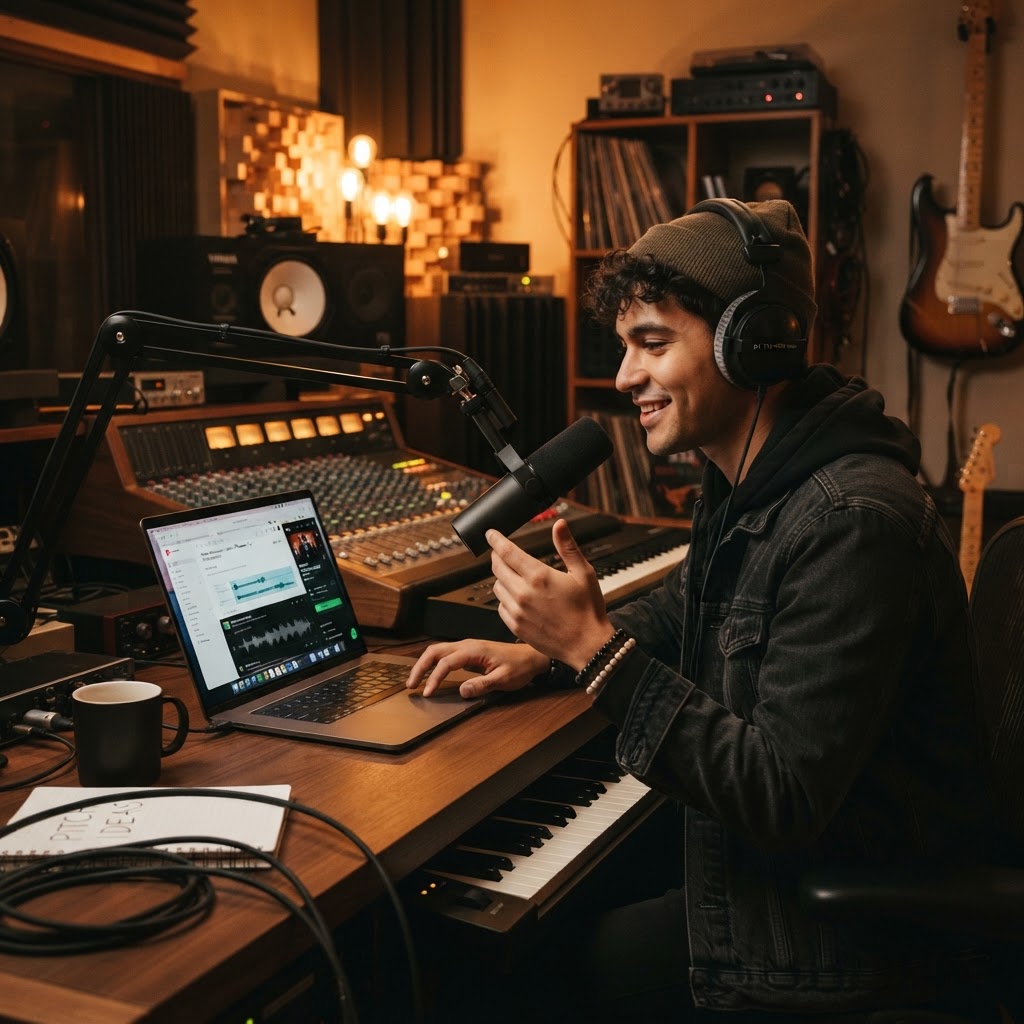
How to Trigger Spotify Algorithmic Playlists: Decoding the Machine
You have spent months in the studio, perfected your mix, and navigated the tedious upload process, only to wake up on release day to stagnant stream counts. You are not alone; thousands of artists face the silent rejection of the Spotify algorithm every single week. Understanding how to trigger Spotify algorithmic playlists like Discover Weekly, Release Radar, and Radio is the single most critical skill for a modern independent musician. This is not about 'getting lucky' with a curator; it is about providing the data points the Spotify machine needs to classify and promote your work. Spotify's ecosystem is built on a massive, interconnected network of vectors—mathematical representations of sound, listener behavior, and artist identity—that define where your music lives in the digital void.
To successfully trigger Spotify algorithmic playlists, you must maximize your listener retention rate and skip-to-save ratio within the first 72 hours of release. The algorithm prioritizes songs where listeners finish the track and subsequently 'save' or 'add' the track to their personal libraries, signaling high engagement and positive sentiment that triggers algorithmic recommendations to similar user profiles.
The Mathematical Thresholds of the Spotify Algorithm
Spotify does not care about your 'vibe' in the abstract; it cares about data density. The platform operates on a massive collaborative filtering engine that clusters users based on shared listening habits. To enter this ecosystem, you need to hit specific benchmarks during your 'launch window.' An algorithmic trigger typically requires a Save Rate of at least 15%—meaning for every 100 listeners, at least 15 add your song to their library—and a Skip Rate of under 30%. If your skip rate exceeds 40% in the first 30 seconds of your track, the algorithm classifies the song as 'low-quality' or 'mismatched,' and will bury the song, regardless of how much you pitch to human curators. Furthermore, the 'Listen-Through Rate' (LTR) must consistently remain above 65% to signal that your content is engaging enough to be moved from 'Test' clusters to wider 'Discovery' clusters.
The Spotify algorithm is not a curator—it is a prediction engine. Every skip is a negative data point, and every save is a high-value signal that informs future placements for thousands of other listeners.
Using the SongBiz dashboard, you can monitor these metrics to ensure your release is hitting the necessary conversion markers. If your data shows a drop-off, it is time to pivot your marketing focus before the 28-day window closes. In the streaming era, the first 28 days are the 'incubation period.' If you fail to generate sufficient positive signals during this window, the track enters a 'zombie' state where the algorithm effectively stops attempting to find new listeners for it.
How to trigger Spotify algorithmic playlists through listener retention?
Retention is king. The algorithm tracks your 'Stream Completion Rate' religiously. If 60% of your listeners finish the track, you are in the top tier of performance. To achieve this, avoid overly long, ambient, or confusing intros; in the current streaming economy, if the song does not hook the listener within the first 10 seconds, the skip button is a certainty. How to trigger Spotify algorithmic playlists effectively means optimizing your structure for these micro-moments. Ensure your sonic identity is clear enough that the algorithm places you in the correct 'seed' categories immediately. If you are an indie-pop artist, your production must share frequency patterns with established artists in that genre. If your song contains experimental or jarring elements, consider placing them in the bridge rather than the intro to prevent immediate skips.
The Anatomy of a 'Save': Why Engagement Velocity Matters
Engagement velocity is the rate at which you accumulate saves and streams in a concentrated period. If you receive 500 streams in one hour, the algorithm perceives this as a 'trending' event, which is significantly more powerful than 500 streams spread out over three days. This is the primary reason why 'waterfall' release strategies and concentrated marketing pushes are superior to slow-drip campaigns. When your SongBiz analytics indicate a spike in engagement velocity, it signals to Spotify that your music has 'social proof.' The algorithm then promotes your track in Discover Weekly to users who share a 'taste profile' with the listeners who just engaged with your music. It is a feedback loop: high velocity leads to algorithmic placement, which creates more velocity.
Why your release day strategy dictates algorithmic success
Many artists make the mistake of waiting for 'playlist placements' before they start driving traffic. This is backwards. You must drive your own external traffic on launch day to 'seed' the algorithm. This is where tools like Meta BOOST or TikTok direct-to-Spotify conversion become essential. By running highly targeted ad campaigns, you can bring high-intent listeners to your track. These listeners are statistically more likely to save the track than a cold listener generated by an organic editorial playlist placement. When you bring 'warm' traffic from your own mailing list or social media, the save-to-stream ratio is usually higher, which validates the track's quality in the eyes of the machine.
- Day 1: Drive all social traffic to your Spotify link. Focus on 'Saves' over 'Streams.'
- Day 2-3: Monitor 'Saves' vs 'Hidden' (or skips) in Spotify for Artists.
- Day 4+: Analyze the 'Source of Streams' data. Are you hitting algorithmic or just direct sources?
- Day 7+: If 'Algorithmic' is not climbing, re-evaluate your target audience and ad creative.
How to trigger Spotify algorithmic playlists using external traffic?

SongBiz for Artists
Pitch your music to vetted curators and PR outlets — all in one platform
SongBiz handles playlist pitching, press outreach, booking, grant funding, and AI content creation so you can focus on making music. No label required. Start free and launch your first campaign in minutes.
Start free with SongBiz →External traffic acts as the catalyst for the algorithm. Spotify tracks 'outside' sources differently than internal ones. When traffic flows from a curated website or a social media ad, Spotify interprets this as 'high-value' because you are bringing a user into their app who might not have been listening otherwise. Using SongBiz, you can streamline your PR outreach to music blogs, which provides that essential external signal to the algorithm. When a user clicks a 'smart link' from a blog or social post and interacts with your song, Spotify rewards this 'external-to-internal' conversion heavily. It confirms that you are not just a 'playlist-filler' but an artist who can cultivate an audience across the internet.
Most artists fail because they pitch to playlists instead of building a fan signal. The algorithm rewards the artist, not the playlist curator. Focus on the listener profile, not the playlist title.
What are the specific benchmarks for 'Release Radar' inclusion?
To get into Release Radar, you need to maximize your 'Followers' count. Release Radar is the most predictable algorithm-based playlist because it relies heavily on follower count and active listening habits. You should aim for a 5-10% follow-through rate on every release. If you have 1,000 followers, you should realistically expect 50-100 streams from Release Radar alone. If you are below these numbers, you need to optimize your call-to-action in your social media content. Remind your audience that 'following' you is the only way to ensure they get notified when you release new music. The algorithm tracks the 'Save' and 'Follow' count within the first 24 hours of your release to determine the priority level of your song within the Release Radar distribution tier.
The Role of 'Listener Context' and Genre Mapping
Spotify uses a complex taxonomy to map genres, moods, and energy levels. If you want to know how to trigger Spotify algorithmic playlists, you must understand your 'sonic profile.' By analyzing the acousticness, danceability, and tempo of your tracks via SongBiz, you can identify which 'cluster' you belong to. If your track is incorrectly tagged or lacks a clear genre direction, the algorithm may place it in too broad a bucket, causing your skip rate to skyrocket as it plays for people who simply don't enjoy that style. Conversely, if you are laser-focused, you will be placed in niche, high-engagement 'Radio' playlists associated with similar artists, which creates a 'domino effect' of discovery.
Maximizing the 'Radio' Feature: The Silent Multiplier
Once your song has achieved a sufficient number of saves and high retention, the 'Radio' feature (triggered by clicking 'Go to Song Radio') becomes a passive engine for your career. This happens when the algorithm 'understands' that your song is a perfect fit for a specific artist or mood. Once you are appearing on the Radio of bigger artists, you have officially cracked the algorithm. This is the goal of every strategic release. You must track your 'Artist Radio' appearance count in your analytics. If that number remains at zero, your SongBiz analysis should focus on improving your 'Save-to-Listener' ratio, as that is the primary metric that validates your position in a Radio rotation.
People Also Ask: How to trigger Spotify algorithmic playlists?
What is the minimum stream count to trigger Discover Weekly?
There is no specific 'magic' number of streams, but the algorithm needs roughly 200-500 high-quality, non-skip streams to begin classifying your track and matching it with similar users in their 'Discovery' clusters. The quality of these streams (user retention and library saves) matters far more than the raw total count.
Do editorial playlists help trigger algorithmic ones?
Editorial placements provide a huge surge of traffic, which can help, but they are not the primary trigger. In fact, editorial traffic can sometimes hurt your algorithmic performance if the listeners are not actually interested in your genre, as this increases your skip rate. Always prioritize targeting the right audience over broad editorial exposure.
Should I use third-party playlist services to trigger the algorithm?
Avoid any service that guarantees streams. These are often bots that will destroy your engagement metrics, raise your skip rate, and cause Spotify to shadow-ban your release, making it impossible to trigger algorithmic playlists in the future. Organic growth is the only sustainable pathway to long-term algorithmic success.
How long does the algorithm take to start working?
The algorithm is not instant. It usually requires 2 to 4 weeks of consistent data to 'learn' who your audience is. Keep your marketing consistent throughout this period rather than burning your entire budget in the first 24 hours. A steady, sustained stream of high-intent, active listeners is far more effective than a single, one-time spike followed by silence.
Why is my skip rate high even with good marketing?
A high skip rate despite strong marketing usually indicates a 'mismatch' between your ad creative and your music. If your social media hook doesn't match the actual sound of your track, listeners will click through but skip immediately upon hearing the song. Ensure your video previews and ads accurately represent the sonic experience of your music to capture the right audience.
The Long-Term View: Consistency and the 28-Day Cycle
Understanding how to trigger Spotify algorithmic playlists requires a shift in mindset from 'one-off' releases to consistent content cycles. Spotify rewards artists who release music regularly because it keeps the platform fresh. Every time you release, you get a fresh data set. If you release once every six months, you are constantly starting from zero. If you release every six weeks, you are continuously feeding the algorithm, allowing it to refine its 'listener profile' for your project. Use your SongBiz data to track which of your releases are performing best, and use those tracks as the 'sonic baseline' for your future production. By aligning your sound with what your audience is actually consuming, you naturally increase your chances of being picked up by the algorithm. Remember, the algorithm is a mirror—it reflects your audience's habits back to you. By nurturing that audience and focusing on high-quality engagement metrics, you stop fighting against the machine and start leveraging it to build a lasting, sustainable music career.
Build your music career without a label
Join thousands of independent artists using SongBiz to get playlist placements, press coverage, booking deals, and grant funding — all from one platform. Start free today.
SongBiz Professional — Pitch. Press. Play. The all-in-one music marketing platform for independent artists. Playlist pitching, PR outreach, booking, grant funding, and AI content creation. Start free →