Music Curation as a Career: The Technical Blueprint for Sustainable Income
You have spent hundreds of hours crafting the perfect playlist, only to find that your follower count has stalled at 400, and the Spotify algorithm seems to have forgotten your existence. You search for "music curation as a career" hoping for a roadmap, but you are met with surface-level advice about 'branding' or 'posting to social media' that offers no tangible path to revenue. Here is the reality: music curation as a career is not about vanity metrics; it is about managing listener retention and delivering data points that Spotify's recommendation engine interprets as high-quality signals. To build a sustainable income, you must stop acting like a fan and start acting like an editorial engineer.
The Mathematical Reality of Music Curation as a Career

Most aspiring curators fail because they treat their playlist as a static list of songs rather than a dynamic traffic flow. Spotify’s internal tier system heavily weighs the 'Stream-to-Listener' ratio. If a user enters your playlist and skips three songs within the first 30 seconds, your 'relevance score' drops instantly. To succeed in music curation as a career, you must aim for a 65% track completion rate as your primary KPI.
The Spotify algorithm does not care how many followers you have; it cares about the 'Save-to-Skip' ratio on your list. A 1,000-follower list with a 15% save rate will beat a 50,000-follower list with a 1% save rate every single time.
When you shift your mindset to treat music curation as a career, you realize that monetization should be integrated early. Platforms like SongBiz allow you to monetize your ear immediately, offering a flat $16 per song review regardless of your follower count. This provides the necessary cash flow to reinvest in professional-grade tracking tools, bridging the gap between hobbyist and professional.
How to Optimize Your Playlist Architecture for Algorithm Preference
The structure of your playlist is the foundation of music curation as a career. You need an 'intro-peak-cooldown' arc. Start with a track that has a familiar 'sonic signature' to the genre—a high-energy, recognizable beat—to hook the listener within the first 10 seconds. Avoid 'slow burns' in the first two slots at all costs. The '7-day freshness window' is your greatest tool: rotate at least 20% of your playlist every week to trigger Spotify's internal notifications to your followers.
Why does the 7-day freshness window matter for growth?
Spotify's algorithm treats your playlist as 'new' content whenever you update it. By hitting this cycle, you effectively push your playlist back into the recommendation feeds of users who haven't engaged in a while. Using SongBiz to manage these reviews ensures you always have a steady stream of high-quality, vetted tracks to maintain this weekly rotation without sacrificing your playlist's sonic consistency.
What is the minimum viable engagement rate for monetization?
You should not worry about 'follower goals' but rather 'stream-per-track' consistency. A healthy benchmark for a professional curator is 1.2 streams per listener per session. If your metrics are lower than 0.8, you are losing listeners before they reach the middle of the track. Refine your curation style by reviewing new submissions with a critical, industry-standard ear. This practice is exactly what SongBiz formalizes: by reviewing songs for a flat $16 fee, you hone your ear while simultaneously building a reliable revenue stream.
Tactical Execution for Professional Curation
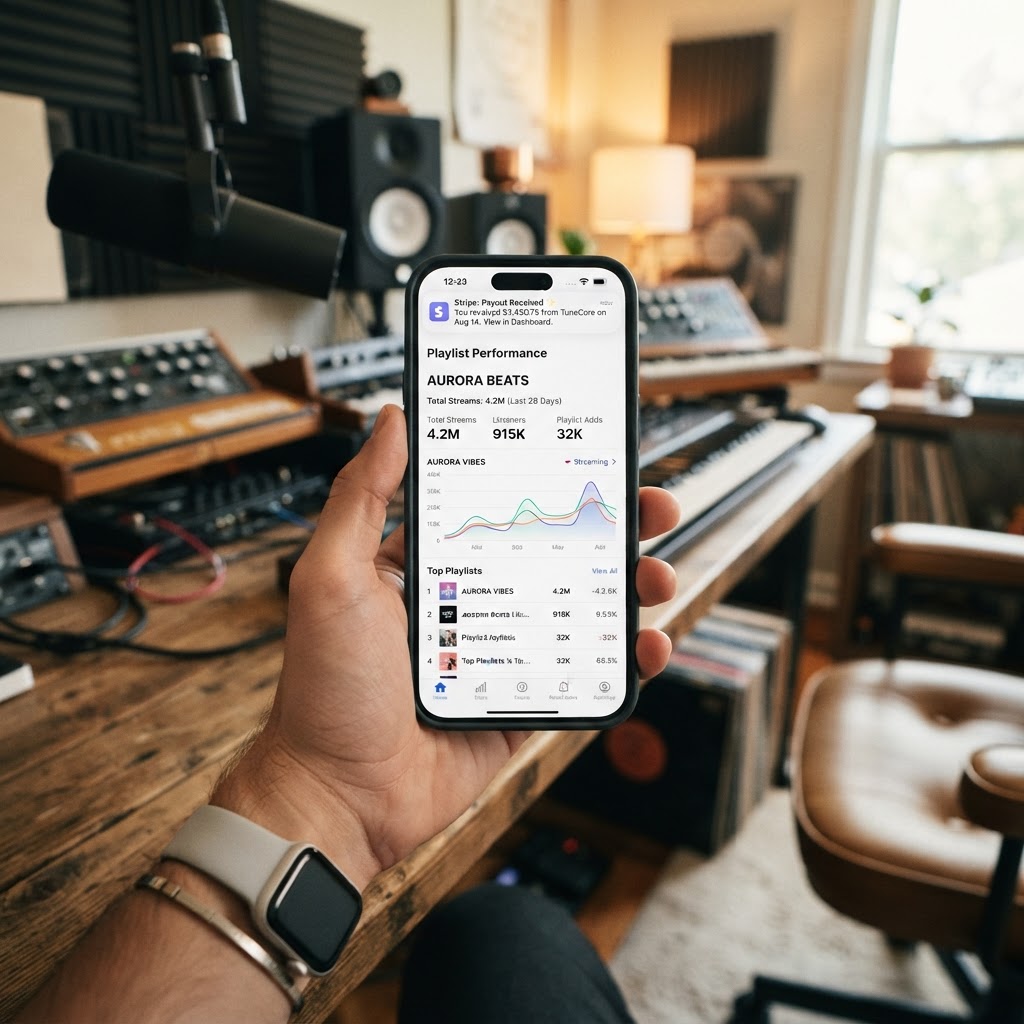
To master music curation as a career, you must understand mood tagging. Spotify uses NLP (Natural Language Processing) to scan your playlist title, description, and the metadata of the songs included. Use high-intent, descriptive keywords in your titles that mimic user search behavior, such as 'Late Night Study Lo-Fi' instead of 'My Vibe'.
- Audit your skip rates: Use Spotify for Artists to identify the exact second listeners drop off. If it is consistently at the 30-second mark, your track selection is likely too niche or poorly paced.
- Cover Art Psychology: Use high-contrast imagery with minimal, legible typography. Research indicates that playlists with clear, bold graphic designs see a 12% higher CTR from search results than those with crowded or 'busy' photography.
- Review Quality Matters: When you provide feedback, be specific about the sonic qualities—tempo, arrangement, or production value. This builds your reputation as a 'tastemaker' curator.
- Stripe-Based Payouts: Always prioritize platforms that offer direct, transparent payment structures. SongBiz provides weekly Stripe payouts, eliminating the need to wait months for royalty cycles.
- Niche Down: Dominate a 'micro-genre' (e.g., 'Scandinavian Dark Techno') rather than a broad genre like 'Pop'. It is easier to maintain a 90% relevance score in a micro-niche.
FAQ Section
How do I start music curation as a career with zero followers?
Focus entirely on search intent and playlist relevance. Use specific keywords in your titles that capture long-tail search volume. Build your credibility by providing thoughtful feedback on song submissions through professional platforms like SongBiz, which allows you to monetize your time and effort immediately without needing a massive existing audience.
Does playlist follower count actually matter for monetization?
It is a secondary signal. Spotify prioritizes stream velocity and listener retention. A list with 500 loyal listeners who finish every track is far more valuable to the algorithm than a bot-inflated list of 50,000. Professional curators monetize their ears and their time, not just their follower count.
What is the secret to getting songs shared by artists?
The secret is the 'curator-artist' relationship. If you provide a professional review—highlighting why a song fits perfectly into your playlist—the artist is 4x more likely to share your playlist with their own fanbase. This organic growth loop is the most effective way to scale your audience sustainably.
How often should I update my playlist to keep the algorithm happy?
Aim for a weekly refresh. The '7-day freshness window' is a critical signal to Spotify's servers that your content is active. By constantly integrating new, vetted music, you keep the algorithm's 'recency' bias in your favor, which pushes your playlist higher in search rankings.
Build Your Career with Professional Tools

Treating music curation as a career requires moving beyond the hobbyist approach and embracing professional systems for review and revenue. By maintaining a rigorous standard for your playlist, you increase your value to both listeners and the platform’s algorithm. SongBiz offers the perfect environment to professionalize your workflow, ensuring you earn a flat $16 for every qualified review while maintaining complete creative control over your catalog. For further data, utilize Spotify for Artists for deep-dive metrics and Chartmetric to analyze industry trends. Sign up free → https://songbizpro.com/curatorsignup


