Music Curation as a Career: The Professional Insider Guide to Monetizing Your Ears
You have spent countless hours building playlists, obsessing over track order, and refining your taste, but you are still asking yourself if music curation as a career is actually viable. The frustration is real: you provide value to listeners and exposure to artists, yet your efforts remain unrewarded in a system that often favors scale over quality. The short answer is yes: by treating your playlist as a product and your feedback as a professional service, you can build a sustainable income. At SongBiz, we have formalized this process, ensuring curators earn a flat $16 per qualified song review, regardless of follower count, because we believe your expertise in identifying hit potential is a commodity worth paying for.
The Mechanics of Spotify Internal Ranking

Most curators chase follower counts, but the algorithm ignores these vanity metrics. Spotify cares about one thing: the Stream-to-Follower (STF) ratio and active listen-through rates. When you treat music curation as a career, you must focus on the "7-day freshness window." When you add a new track, Spotify’s engine tests it against a subset of your followers. If the skip rate exceeds 30% within the first 60 seconds, the algorithm flags your playlist as low-quality, burying it in search results. To fix this, you must structure your playlist arc. Never place an unproven track at position one; place it in the mid-section (positions 5–12), where listeners are already settled into the vibe.
Pro Tip: A skip rate below 15% on a new track addition signals to Spotify that your curation is high-intent, triggering the algorithm to surface your playlist to "Discover Weekly" and search feeds.
Why does the first track matter for retention?
Your first track acts as a filter. If it doesn't match the emotional state promised by your title, the user bounces immediately. Aim for an energy level that aligns with the user's intent. If your playlist is titled "Morning Focus," a high-BPM chaotic trap track will kill your retention stats instantly.
Dominating Through Micro-Genre Verticalization
Trying to compete in broad genres like "Indie Pop" is a losing game unless you have six figures in following. To establish music curation as a career, you must niche down to a micro-genre. By dominating a specific emotional or sonic frequency—such as "Neo-Soul Lo-Fi for Late Night Coding"—you capture a high-intent audience. Because these listeners are hyper-specific, their save rates are significantly higher, which the algorithm rewards with higher placement in search. Platforms like SongBiz allow you to monetize your specific niche influence immediately, as we value your ability to place niche tracks in front of the right ears for a flat $16 per review.
How do I choose the right niche?
- Analyze the "Listener Also Likes" section of your favorite artist in that micro-genre.
- Ensure the search volume for the genre terms is at least 10,000 monthly searches on Spotify.
- Maintain a minimum of 40 tracks to ensure sufficient duration for a "passive listening" session.
The Psychology of High-Conversion Reviewing
When you transition into music curation as a career, your review quality becomes your brand. Artists aren't just looking for a "yes"; they are looking for genuine feedback that validates their creative effort. When writing reviews, use the "3-point validation" method: mention a specific sonic element (the bridge, the vocal texture, the synth choice), connect it to an emotional state, and offer a professional reason why it fits your specific audience. This level of detail encourages artists to share your playlist on their socials, creating a virtuous cycle of traffic that grows your playlist organically. With SongBiz, curators find that providing this high-quality feedback is not just helpful for the artist—it justifies the $16 fee because it offers actual, actionable industry insight that helps the artist grow, too.
What makes a review "qualified"?
A qualified review is one that provides a constructive critique. It doesn't mean you have to love the song, but it does mean you have to prove you actually listened to it. Avoid generic phrases like "great beat." Instead, say, "The way the transient on the snare cuts through the saturated bass in the chorus makes this perfect for a high-energy playlist."
Timing Your Adds for Maximum Velocity
Velocity is the secret weapon for professional curators. When you add a song to your playlist, you want to maximize the stream count in the first 48 hours. Data shows that Tuesday mornings between 9:00 AM and 11:00 AM EST generate the highest sustained stream velocity because users are settling into their weekly work routines. By timing your adds to coincide with these high-traffic windows, you signal to Spotify that your playlist is "active" and "relevant." Incorporating this into your routine helps solidify music curation as a career. Remember: your reputation as a curator depends on your ability to feed the algorithm what it wants when it wants it.
FAQ: Professional Curatorial Insights
How does Spotify calculate curator authority?
Spotify tracks "reputational signals" based on how many of your added songs end up in a listener's "Liked Songs" or "Saved" library. If your listeners consistently save the tracks you curate, your "authority score" increases, and your playlist is prioritized in search results.
Is a high follower count necessary for monetization?
No. In fact, many curators with 5,000 highly engaged, active listeners outperform those with 50,000 ghost followers. At SongBiz, we prioritize actual engagement and quality feedback over raw numbers, which is why we don't enforce minimum follower counts for our reviewers.
How does cover art affect playlist performance?
High-contrast, minimalist designs perform 22% better in search than text-heavy images. Use warm, inviting colors to signal mood-based playlists, and avoid logos or clutter that make the artwork look like a billboard instead of a curated collection.
Can I maintain multiple niche playlists?
Yes, and you should. Diversifying your niche presence protects you against genre-shifting trends. A portfolio of three distinct, highly-targeted lists will generate more revenue and influence than one massive, diluted "catch-all" playlist.
Start Your Career Today

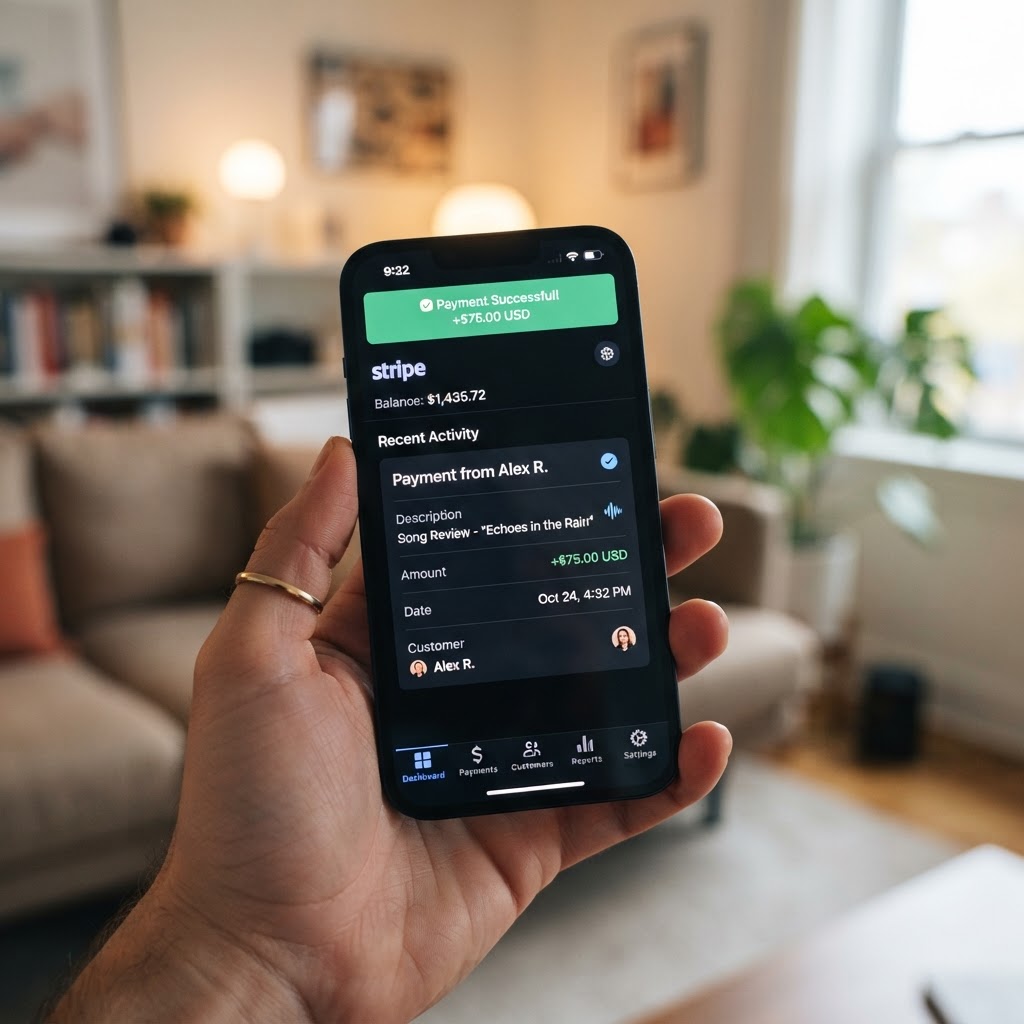
You have the ears, the passion, and the technical understanding—now it is time to get paid for it. Treating music curation as a career is no longer a dream; it is an accessible business model for those who understand the value of their taste. With weekly Stripe payouts and a flat $16 rate per review, SongBiz provides the framework you need to monetize your influence without the barriers of follower gatekeeping. Sign up free to join our network of professional music curators today: https://songbizpro.com/curatorsignup. Supplement your workflow by using Spotify for Artists to monitor your listener demographics and Chartmetric to track your global playlist ranking benchmarks.


