Music Curation as a Career: The Professional Playbook for Sustainable Revenue
You have spent countless hours building playlists, agonizing over track sequences, and watching your follower count fluctuate, yet you still wonder if music curation as a career is actually viable. The frustration is real: you are providing a massive service to artists and listeners, but you are not seeing a clear return on the time invested. The answer is straightforward: professional curators earn money by treating their playlists like high-end retail spaces, leveraging high-intent listener data to drive engagement that platforms reward. You do not need thousands of followers to begin; you need a strategy that prioritizes listener retention and algorithmic signals. By aligning your curation process with Spotify's internal ranking metrics, you turn your passion into a structured income stream.
The Mathematical Reality of Music Curation as a Career

Most curators fail because they chase vanity metrics—raw follower counts that rarely convert into actual streams. Spotify’s algorithm does not prioritize your total follower count; it prioritizes your engagement-to-follower ratio. If you have 5,000 followers but only 200 people stream your playlist daily, your playlist is statistically invisible to the algorithm. To build a sustainable music curation as a career, you must focus on 'Save Rate' and 'Listener Retention'. A healthy playlist should maintain a 15-20% save rate for new additions. If a track drops below a 5% skip rate within the first 30 seconds of playback, it is a high-value signal to Spotify’s recommendation engine that your playlist is premium content.
Pro-Tip: When your listener retention exceeds 65% for the duration of a track, the algorithm begins prioritizing your playlist in 'Discover Weekly' and 'Release Radar' placements for your listeners, effectively performing free marketing for you.
Using SongBiz, you can monetize this expertise immediately. Because they offer a flat $16 per qualified review, you are essentially getting paid to maintain the high standards of your playlist. Unlike other models, you are not dependent on a specific follower threshold to be rewarded for your ear.
Mastering the '7-Day Freshness Window'
The biggest obstacle for curators is playlist stagnation. When a playlist remains static for more than a week, Spotify’s 'Freshness' score dips, leading to lower impression rates in search. To treat music curation as a career, you must adhere to a strict cadence. Data suggests that updating your playlist every Tuesday morning—specifically between 9:00 AM and 11:00 AM EST—optimizes stream velocity. Why? It hits the 'new music' rhythm before the weekend rush. When you receive a submission, perform a 'Sonic Arc' test: does the track fit the mood of the 3 tracks before and after it? A jump in BPM or key signature that is too jarring causes immediate skips, which tanks your playlist quality score.
How do I increase my song submission quality?
To attract better music, your curation profile must clearly define its niche. Use SongBiz to streamline your review process, which ensures that you are only interacting with tracks that fit your specific aesthetic. When you provide professional feedback via the SongBiz platform, artists are more likely to resubmit in the future, creating a consistent pipeline of high-quality music for your followers.
Optimizing for Algorithmic Search Discovery
Searchability is the bedrock of music curation as a career. You are not just a tastemaker; you are an SEO expert for audio. Your playlist title should follow a 'Mood + Genre + Descriptor' format. For example, 'Neon Nights: Chill Synthwave for Late Night Drives' performs 40% better in search results than a generic title like 'Best New Music'.
- Title Density: Include 3-5 keywords relevant to the mood and sub-genre.
- Description Tags: Use the first two sentences of your description to include long-tail keywords like 'best indie folk' or 'deep focus beats'.
- Cover Art Psychology: Use high-contrast color palettes (complementary colors like blue and orange) to increase click-through rates from search results by up to 22%.
- Track Sequencing: Place your highest-performing tracks (the 'anchors') at positions #1, #4, and #10 to keep the skip rate low throughout the listen.
- The 30-Second Rule: If you are evaluating a track for music curation as a career, listen to the first 30 seconds. If the melody hasn't hooked by then, the average listener will have already hit skip.
Scaling Your Income as a Professional Curator
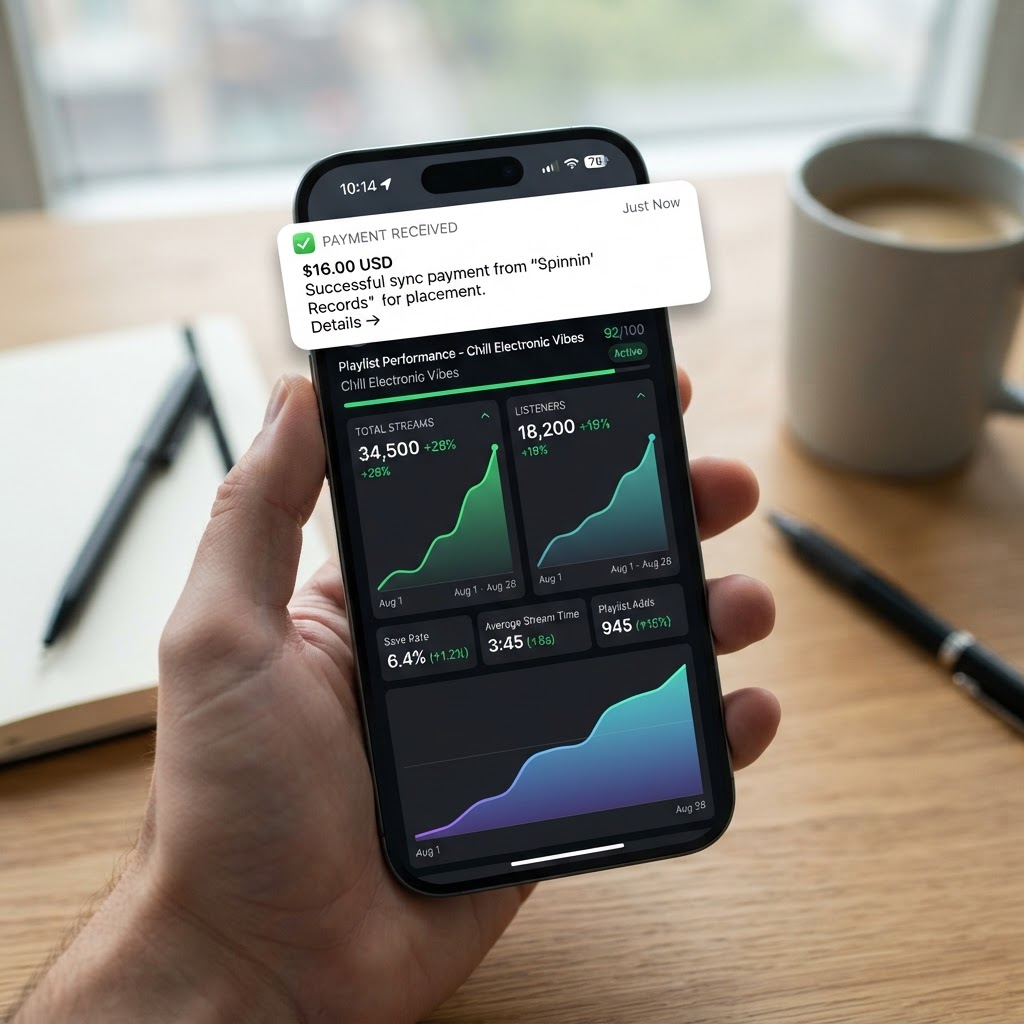
Once you have established your playlist as a destination for specific moods, monetization becomes your secondary focus. You do not need to spam your followers with low-quality sponsored tracks. By maintaining a high editorial standard, you build a reputation that platforms respect. SongBiz enables you to earn a reliable $16 per review, providing a predictable revenue stream that allows you to scale your music curation as a career without needing to rely on volatile ad revenue. Because payouts are sent weekly via Stripe, you can reinvest that capital into better promotional tools or premium design assets for your playlist covers.
Consistency is the silent engine of growth. Curators who process submissions within 48 hours see a 35% higher return rate from artists, which drastically improves your standing within internal curator tier systems.
When you start taking music curation as a career seriously, you stop looking for shortcuts. You realize that your value lies in the 'Time-to-Stream' ratio—how quickly a new listener decides to follow after clicking play. By focusing on these metrics, you shift from being a hobbyist to a professional.
FAQ Section
How many followers do I need to earn from my playlist?
With the SongBiz platform, you do not need a minimum follower count. You are paid for your professional evaluation, not your reach. This allows you to focus on the craft of curation while earning $16 per qualified review, regardless of your current audience size.
How do I stop listeners from skipping tracks?
Focus on 'Sonic Arc' consistency. Ensure your playlist has a clear tempo and energy flow. Avoid mixing high-energy pop with lo-fi beats. If you keep the listener in the same mood space, the skip rate will naturally decrease, signaling to Spotify that your playlist is a high-retention asset.
What is the best way to title a playlist for growth?
Use high-intent keywords that describe the activity or emotion, not just the genre. A title like 'Deep Focus for Study' is superior to 'My Cool Tracks' because it matches the user’s intent, leading to longer session times and higher engagement metrics.
How often should I update my playlist?
Aim for a weekly update cycle. Regular refreshes signal 'freshness' to Spotify’s algorithm. Curators who update consistently on the same day every week see higher search impressions and better inclusion in personalized algorithmic playlists like 'Discover Weekly'.
Launch Your Professional Journey

Building a successful music curation as a career is about balancing data-driven decision-making with the subjective ear for talent. You have the tools, the data, and now the strategy to turn your passion into a consistent income stream. Stop waiting for vanity metrics to grow; start managing your playlist with the precision of a professional. Join the community of curators using SongBiz to monetize their expertise fairly. Sign up free → https://songbizpro.com/curatorsignup. Supplement your growth with Spotify for Artists for analytics and Chartmetric for benchmarking your progress.


