How to Book Your First Tour Without a Booking Agent: The DIY Blueprint
You have the music, you have the vision, but you are stuck in your bedroom because you do not know how to book your first tour without a booking agent. It is the classic independent artist paradox: venues will not book you without a draw, but you cannot build a draw without playing shows. The frustration of stagnant growth and zero touring revenue is the primary barrier to a sustainable career. Learning the architecture of a tour is not just about finding stages; it is about building a scalable business model that treats every city as a unique data point.
To book your first tour without a booking agent, focus on a 150-mile radius "micro-tour" strategy. Use platform analytics to verify where your listeners live, reach out to talent buyers at mid-sized dive bars with a professional electronic press kit (EPK), offer to support established local acts to leverage their audience, and guarantee the venue a specific "headcount threshold" in exchange for a door deal rather than a flat fee.
Why Most DIY Tours Fail: The Data Gap
The biggest mistake independent artists make is "dartboard routing." They email every venue in the country, hoping for a bite. This is a 0.5% success rate strategy. Professional booking is about density. You need to prove you can move at least 30 to 50 tickets in a market you have never visited. If your Spotify for Artists data shows you have 200 monthly listeners in a city, that is your target. Using tools like SongBiz to manage your PR outreach and track your listener data ensures you aren't pitching into the void.
Furthermore, most artists fail because they lack "local buy-in." A venue isn't just selling your music; they are selling an experience to their regulars. If you are a total unknown, you must present yourself as a "plug-and-play" asset. This means having your own professional tech rider, a high-fidelity EPK, and a clear understanding of the venue’s capacity constraints. If you pitch a 500-cap venue with 50 monthly listeners in that zip code, your email will be deleted instantly. Aim for the "Goldilocks Zone": venues between 80 and 150 capacity. They are hungry for content on weeknights and offer the best leverage for a growing act.
Pro Tip: Never ask a talent buyer for a "show." Ask them for a specific date supporting a band that fits your genre. Talent buyers care about one thing: the bar tab. If you cannot guarantee a draw, you must offer them an act that can.
How to Identify High-Value Markets for Your Tour
You cannot effectively learn how to book your first tour without a booking agent if you are guessing where to go. Use the "Fan Heatmap" feature in your streaming backend. Identify the top 5 cities where your listeners are concentrated. If you don't have enough data, look at where similar artists in your niche are playing. If a band with 10,000 monthly listeners is playing a 200-cap room in a specific city, that venue is likely a viable target for you. Aim for venues with a capacity of 100-200. Anything larger is a money pit without a massive local promo machine.
You must also audit the "venue ecosystem." Does the club have an in-house sound engineer? Do they provide backline (drums/amps)? If you have to haul a full kit across state lines, your overhead costs will devour your touring revenue. Use SongBiz to research the specific specs of venues before you reach out. A venue that provides backline is worth 20% more in actual profit because it saves you on trailer gas and potential gear damage.
People Also Ask: What is the ideal length for a first tour?
For your first run, stick to 3-5 dates within a 5-day window. This minimizes travel costs and fuel consumption, which are the primary reasons artists lose money on the road. A "weekend warrior" circuit allows you to keep your day job while building a sustainable touring habit. Once you master the routing for 5 dates, scaling to 10 or 15 becomes a matter of repeating the same successful outreach workflow.
People Also Ask: How do I measure if a city is worth a return trip?
Use the "80/20 Rule of ROI." If you reach 80% of your projected attendance goal and collect at least 25 new email addresses on your mailing list during the show, that city is a "keeper." If you fall below these benchmarks, re-evaluate your marketing strategy in that market before returning. Data-driven touring ensures that your second tour is always more profitable than your first.
The Anatomy of a Perfect Booking Email
When you reach out to talent buyers, you have exactly 10 seconds of their time. Your email should contain: 1. A link to a live video (not a studio track), 2. Your "draw" (how many people you can realistically bring), 3. Your social proof (recent press, playlist placements, or a solid Spotify milestone). If you don't have this, use the SongBiz platform to boost your presence and gather the professional assets you need to look like an artist who belongs on the stage.
- Subject Line: [Artist Name] / [Genre] // Date Inquiry: [Preferred Dates]
- The Hook: One sentence identifying your sound-alike (e.g., "Think of us as a modern blend of X and Y").
- The Evidence: Link to a YouTube video of a live performance—not a music video. Buyers need to see that you can perform.
- The Ask: "We have a dedicated following in [City] and are looking for a support slot on [Date Range]."
- Attachment: A single PDF link to your EPK. Never send large files that clog an inbox.
Insider Truth: Talent buyers are overwhelmed. If they don't respond, follow up exactly 7 days later. A second, polite touchpoint increases response rates by nearly 40%. After that, move on to the next venue. Do not take silence personally; it is an administrative bottleneck.
How to Negotiate Your First Door Deal

SongBiz for Artists
Pitch your music to vetted curators and PR outlets — all in one platform
SongBiz handles playlist pitching, press outreach, booking, grant funding, and AI content creation so you can focus on making music. No label required. Start free and launch your first campaign in minutes.
Start free with SongBiz →Learning how to book your first tour without a booking agent requires negotiating skills. Never settle for a "we will see how the night goes" agreement. Always request a "door deal." A standard starting point is an 80/20 split in the artist's favor, but expect to settle for 50/50 until you prove your draw. If you are struggling to find venues, leverage your SongBiz dashboard to find PR outlets that can feature your upcoming dates, giving you the leverage to show the venue you are actively promoting the show.
When you negotiate, focus on the "Total Value" you bring. If you are bringing a local opener who has a following, mention that. You are effectively acting as the promoter. When the venue sees that you are willing to handle the flyer distribution, the social media event page creation, and the local press outreach, they are much more likely to agree to a higher door split. Always confirm the details in a written email trail before you step foot in the venue.
The Logistics of Independent Touring: Survival Tactics
Once the dates are confirmed, you must master the mechanics of the road. A tour is essentially a mobile logistics operation. You need a centralized hub for your routing, and spreadsheets are your best friend. Create a master sheet that tracks every single expense—gas, food, parking, and load-in times. If you are not tracking your expenses, you are not touring; you are vacationing. Use SongBiz tools to monitor your digital growth spikes after each show to correlate your touring effort with real-world fan acquisition.
You must also standardize your load-in procedures. If you show up to a 100-cap venue with a 45-minute setup time when you were allotted 15, you will lose the favor of the sound engineer. The sound engineer is the most important person in the room for your success. Be early, be kind, and keep your stage volume reasonable. If you make the sound guy’s life easy, you will get a better mix, a better show, and likely a recommendation for future dates. In the DIY circuit, reputation is currency.
People Also Ask: Should I pay to play?
Never pay to play. If a venue asks for a "rental fee" or "ticket guarantee" that you have to cover out of pocket if you don't sell enough tickets, walk away. Legitimate venues earn their money from the bar. If they don't believe in the show enough to take a risk on the door split, you shouldn't be playing there. True professional development comes from playing in venues that are invested in your growth, not those looking to exploit your desperation.
Building a Repeatable Touring Workflow
The final stage in mastering how to book your first tour without a booking agent is creating a system. You should be spending 5 hours a week dedicated to "Tour Admin." This includes updating your mailing list, checking in with local promoters, and refining your social media assets. Use the SongBiz AI Content Studio to create posters and promo videos in minutes so you have professional-grade marketing materials for every stop on your tour. Consistency here separates the hobbyists from the career musicians.
Your workflow should involve a "Review Phase" after every tour. What worked? Which cities were "dry" and which were "gold"? If a city showed promise, contact the venue immediately for a return date 3-4 months out. This is how you build a touring cycle. The best artists don't just tour; they inhabit specific regions, becoming local favorites through consistent presence. This "regional saturation" is the exact path that booking agents look for when they eventually reach out to sign you.
Scaling Your Touring Revenue
Once you have completed your first 5-date run, you have the "proof of concept." You can now email larger venues and mention that you sold out your last date in a specific market. This is the pivot point. Your goal is to increase your average ticket price by $2-3 per tour while increasing your venue capacity by 20%. Keep track of your "cost per fan acquisition" via Meta ads—SongBiz provides the tools to run these campaigns effectively—to ensure that your touring growth is backed by a growing digital audience.
As you scale, start incorporating merchandise as a core pillar of your revenue. Your touring revenue should be broken down into three buckets: 1. Door splits (covering transport), 2. Performance fees (once you have draw), and 3. Merchandise (your actual profit margin). A well-designed merch table with a QR code leading to your SongBiz-optimized mailing list can turn a break-even show into a profitable night. If you aren't selling merch, you are leaving 30-50% of your touring revenue on the table.
People Also Ask: What if the show is empty?
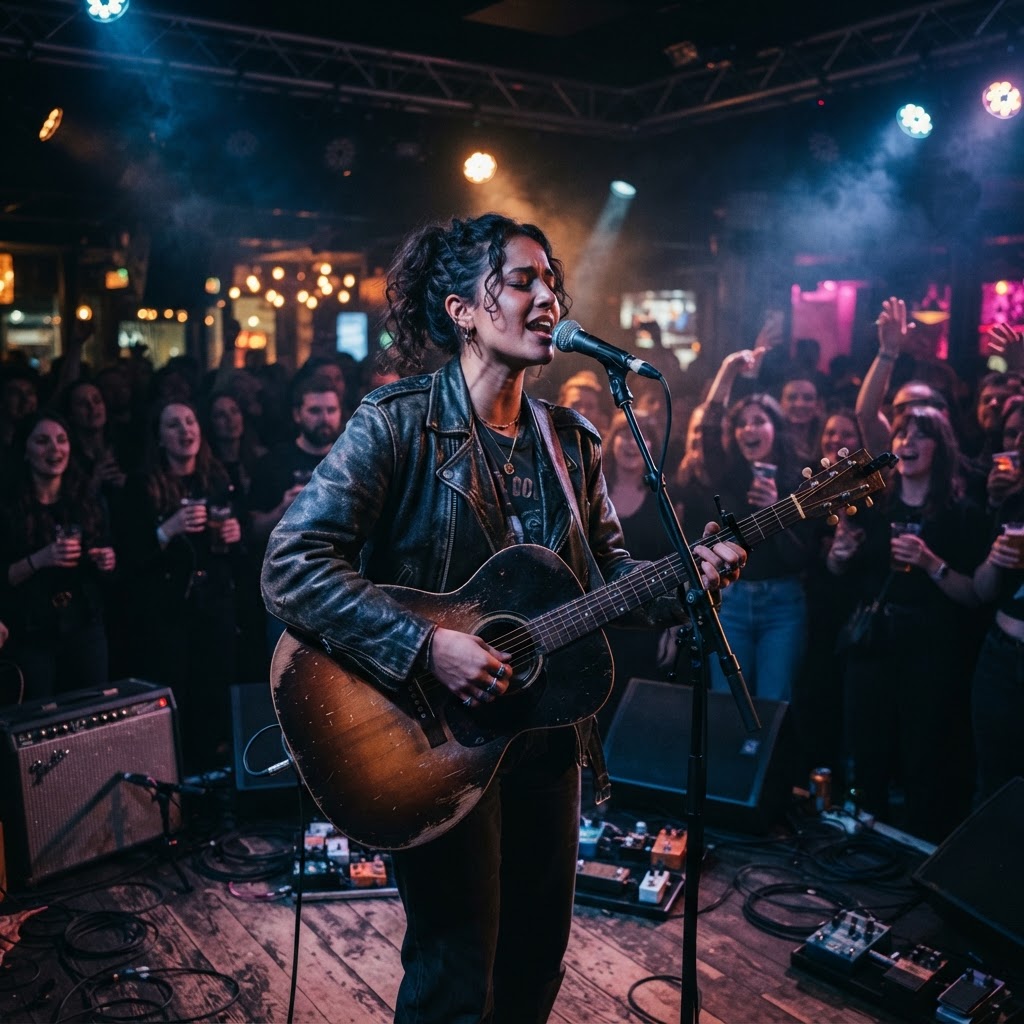
Treat every empty room as a marketing opportunity. You are there to network with the staff and the other band. If only 5 people show up, play like you are in an arena. Those 5 people will be your core fans. Record the set, take high-quality photos, and use that content to fill your socials. The goal is to build an online narrative of "momentum" that you can use to pitch the next venue. An empty room is only a failure if you leave without creating content that makes the next room look full.
The Psychology of the DIY Road
Beyond the logistical tasks, touring requires a specific mindset. You will face van breakdowns, cancellations, and nights with near-zero attendance. The artists who succeed are the ones who view these as "tuition." You are paying for the experience of the road. SongBiz understands that the path to a professional career isn't linear—it’s a series of iterative improvements. Keep your data clean, your outreach professional, and your long-term vision clear. Every single show you book yourself is a lesson in business, and every dollar you earn through a self-booked tour is a testament to your capability as an independent entrepreneur. Stay persistent, stay data-driven, and you will eventually find yourself moving from the bedroom to the stage, one city at a time.
Build your music career without a label
Join thousands of independent artists using SongBiz to get playlist placements, press coverage, booking deals, and grant funding — all from one platform. Start free today.
SongBiz Professional — Pitch. Press. Play. The all-in-one music marketing platform for independent artists. Playlist pitching, PR outreach, booking, grant funding, and AI content creation. Start free →