How to Tour as an Independent Musician Without Losing Money
You have spent thousands on recording and months on social media, yet your inbox is empty of booking offers and your bank account is dwindling every time you consider hitting the road. This is the classic trap of the modern independent artist: wanting to play shows, but lacking the infrastructure to make them pay. Learning how to tour as an independent musician is not just about loading gear into a van; it is about treating your routing like a logistics business and your fanbase like a recurring revenue stream. The reality is that touring is an operation of margin management. Most artists fail because they view touring as an exercise in vanity—a way to prove they are "real musicians"—rather than an exercise in unit economics.
To successfully tour, identify your top geographic listener hubs using your Spotify for Artists data, map a route connecting cities with a minimum of 500-1,000 monthly listeners per radius, and use targeted Meta ads to sell tickets 60 days before the date. By automating your outreach and utilizing platforms like SongBiz, which offers an all-in-one toolkit for booking and marketing, you can build a sustainable, profitable circuit without needing a label. You are essentially building a scalable retail chain; every city is a storefront, and your music is the product. If the store isn't profitable, you don't keep the lights on.
How Do You Find Venues That Actually Book Independent Artists?
The industry secret is that promoters do not care about your 'vibe'; they care about your 'draw' and your 'data'. If you approach a venue without proof that you can sell tickets, you are invisible. Professional booking hinges on the '3-Tier System'. Tier 1: Local clubs (50-100 capacity) where you have already sold 30 tickets. Tier 2: Regional support slots (200-400 capacity) opening for national touring acts. Tier 3: Festival slots. For Tier 1, you must demonstrate a history of local engagement; for Tier 2, you must provide a "support deck" showing that your sound aligns with the headliner's demographic to ensure the promoter sees you as an asset who will help fill the room early.
To secure these, stop sending generic emails to general 'info@' addresses. Use SongBiz to streamline your PR outreach and booking proposals, ensuring your pitch includes your most recent engagement metrics and Spotify streaming trends. A successful booking pitch response rate usually hovers around 5-8% for cold emails. If you aren't hitting that, your pitch isn't the problem—your data is. Focus on building a local "street team" of 10-20 superfans in key markets who can guarantee a baseline attendance of 20 people. When you provide a promoter with a guaranteed headcount, your booking success rate spikes to 40%. You are removing the risk from their balance sheet, which is the most powerful negotiation tactic in the industry.
Pro Tip: Venues rely on bar revenue. If you offer to promote the show across your own social media channels using Meta BOOST, you show the venue owner that you are a partner in their revenue, not just a performer seeking a check. Calculate your "Bar Spend Value"—if you bring 50 people, and each spends $20, you have just brought the venue $1,000 in revenue. Pitch that number to the talent buyer.
How to Calculate Your Touring Budget for Maximum Profitability
Most independent artists lose money because they ignore the 'break-even threshold'. Before you book a single date, calculate your total costs: gas, vehicle rental, insurance, hotels, and per diems. If you are a solo artist or a three-piece, your daily overhead shouldn't exceed 40% of your projected gross show earnings. If you are projected to make $500, your total costs must stay under $200. This is how to tour as an independent musician sustainably. Use a master spreadsheet to track 'Hard Costs' (gas, tolls, parking) versus 'Soft Costs' (merch inventory, marketing). If the 'Hard Costs' exceed 60% of your guaranteed payout, you have a negative-sum game.
Utilize the SongBiz AI Content Studio to generate tour-specific promotional materials, ensuring your marketing assets are high-quality without the expense of a design agency. Run Meta ad campaigns targeting listeners in the specific city you are visiting. A successful conversion rate for ticket sales via Meta ads is generally 2-4%. If your ads aren't converting, your audience segmentation is likely too broad. Target micro-genres of similar artists, not just the mainstream giants. Furthermore, build in a "contingency fund" of at least 15% of your total budget. Van breakdowns, parking tickets, and venue equipment rental fees are inevitable. If you don't budget for the unexpected, the tour effectively ends at the first sign of trouble.
The Science of Routing and Geographic Density
Routing is not just about connecting dots on a map; it is about minimizing 'dead air'. Never drive more than 5-6 hours between shows. Anything longer creates 'transit fatigue', which leads to poor performance and increased fuel costs. Map your tour in clusters. A 'three-state circuit' is the gold standard for independent growth. By hitting the same three states every four months, you build a relationship with local venues and promoters, making you a 'known quantity'.
When you rotate through these cities, keep a record of your 'per-cap' (merch sales per person). If you play a venue with 100 people and sell 10 shirts, your per-cap is $10. Tracking this metric across different cities allows you to see where your brand is strongest. If you have high attendance in City A but low per-cap, it suggests that your audience is there for the music but not necessarily invested in your brand identity. Use SongBiz to analyze which cities yield the highest merch conversion so you can double down on your most profitable territories.
People Also Ask: What is the minimum listener count needed to start touring?
You should aim for at least 1,000 monthly listeners within a specific 50-mile radius of the venue. Without this density, your 'draw' will likely be under 10 people. Focus on regional clusters—don't tour the whole country; tour a three-state 'triangle' where your streaming data is strongest. Use tools like SongBiz to track your growth across these territories.
People Also Ask: How can I estimate my merch-to-ticket conversion rate?
A healthy independent touring benchmark is 15-20% of your ticketed audience buying at least one physical item. If your attendance is 50 people, aim for 8-10 sales. If you fall below 10%, audit your display—is it visible? Is your merch priced in round numbers for faster transactions? Using digital payment processors with contactless tap features is essential for maximizing these numbers.
How to Build a Fanbase That Actually Buys Tickets
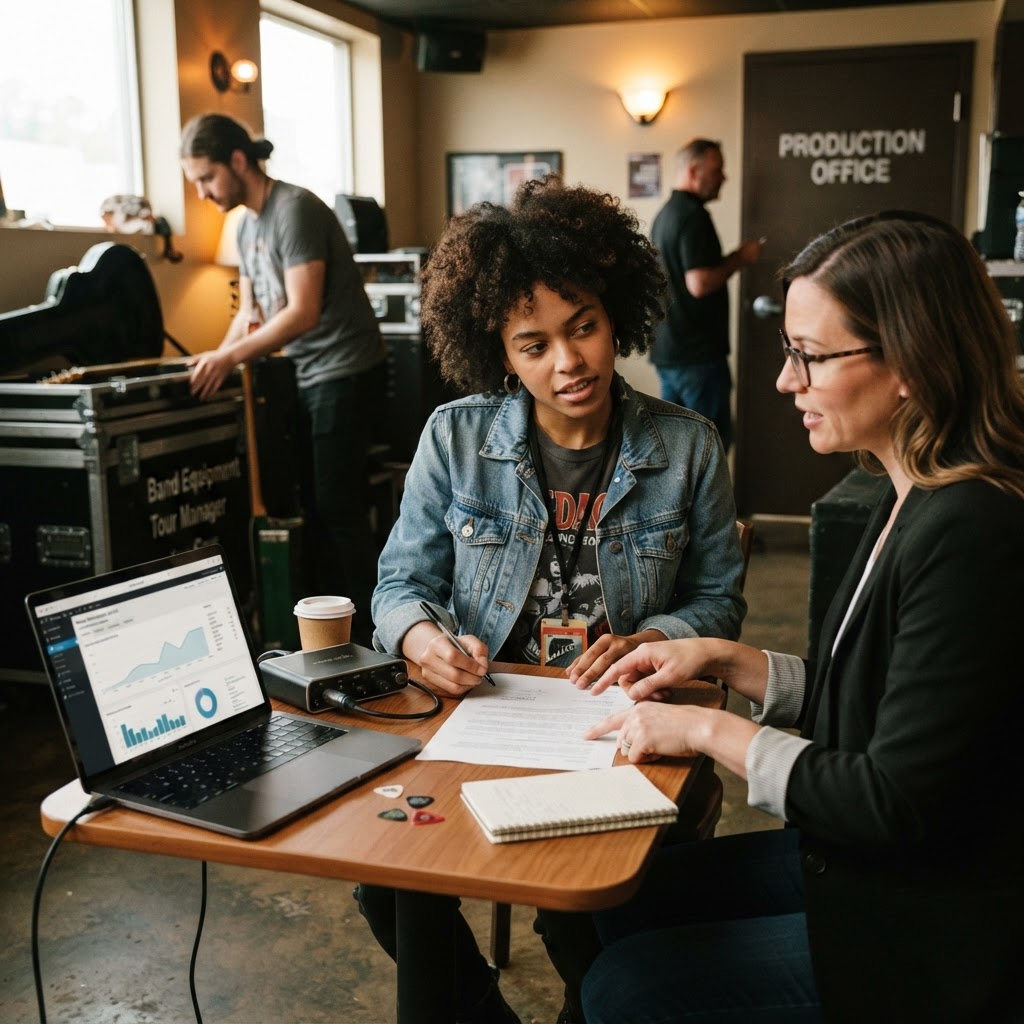
SongBiz for Artists
Pitch your music to vetted curators and PR outlets — all in one platform
SongBiz handles playlist pitching, press outreach, booking, grant funding, and AI content creation so you can focus on making music. No label required. Start free and launch your first campaign in minutes.
Start free with SongBiz →The biggest mistake is thinking that high streams equal ticket sales. They don't. Streams are awareness; ticket sales are conversion. You need to transition your listeners from passive streamers to active 'buyers'. How to tour as an independent musician effectively means leveraging the platform shift: move listeners from Spotify to an email list or a SMS marketing tool. You should have at least 5% of your Spotify monthly listeners on an email list before you announce a tour.
- Step 1: Segment your Spotify audience by city using listener location data.
- Step 2: Create a 'Tour Interest' mailing list sign-up page specifically for the upcoming route.
- Step 3: Run targeted Meta ads to these segments three weeks prior to show announcements to prime the pump.
- Step 4: Send early-bird ticket codes exclusively to your email list 48 hours before general release to create urgency and exclusivity.
- Step 5: Follow up with personal 'thank you' messages from your AI-assisted social profiles, tagging fans who shared your tour posts.
This "funnel" approach mimics the marketing tactics used by major touring acts. The goal is to reach your 'die-hard' fans first. If you can sell 20-30% of your venue capacity via your pre-sale list, you demonstrate momentum to the venue manager, which secures you better pay and more professional production support for future visits.
How to Get Grant Funding for Your Tour
Touring is expensive, but it is one of the few areas where non-dilutive funding is available. Governments and private foundations, such as the Music Export Bureau or national arts councils, provide grants specifically for 'touring and audience development'. To succeed, your application must include a professional 'Touring Plan'. This plan needs to show that you are building your career independently. SongBiz acts as a centralized dashboard for these opportunities, helping you gather the necessary metrics and professional documents to qualify for funding rounds. Every grant committee looks for the same three things: financial literacy, proof of impact, and a long-term professional roadmap.
Insider Truth: Grant committees reject 90% of applications because they lack a 'Sustainability Narrative'. They don't want to fund a one-off vacation; they want to fund a project that proves you can continue to generate revenue long after the tour ends. Include a "Post-Tour Retention Plan" in your application, detailing how you will use the tour's data to grow your mailing list and digital presence.
The Logistics of Merch Management
Merch is often the difference between a tour that nets $500 and one that nets $5,000. Never carry more inventory than you can move in two weeks. Excess inventory is "dead capital" that occupies valuable space in your van and ties up your cash flow. Practice "Just-in-Time" inventory management: order smaller batches based on the specific city's demographics. If you are playing a metal show, prioritize dark colors and heavy-duty designs. If you are playing an indie-pop venue, focus on aesthetic, minimalist apparel.
Ensure you have a designated "Merch Table Manager" if you are a solo artist or a very small group. If you are busy talking to fans, you are losing sales. Your merch table should be illuminated, organized by size, and feature clear pricing. Using a tablet-based POS system (like Square) that tracks inventory in real-time is non-negotiable. It provides the data you need for your SongBiz analytics to decide what products to produce for your next run.
How to Effectively Run Meta Ad Campaigns for Shows
When asking how to tour as an independent musician, the answer often lies in your digital marketing spend. Never run 'boosted' posts. Use Meta Business Manager to create 'Conversion' campaigns with the goal of 'Link Clicks' or 'Ticket Sales'. Target your ads to fans of 5-10 artists in your genre who have recently played your target city. Your cost-per-click (CPC) should ideally be under $0.50. If you are spending $1.50 per click, you are targeting too broadly or your creative (generated via SongBiz AI) isn't resonating.
Effective ad creative follows the 'AIDA' model: Attention (stunning visual or hook), Interest (a snippet of your best song), Desire (the exclusivity of the live show), and Action (a clear "Get Tickets" button). Retargeting is your secret weapon. Create a 'Custom Audience' of everyone who clicked on your ad but didn't buy a ticket, and serve them a different ad showing a testimonial or a live video clip of a high-energy moment from a previous show. This second 'touchpoint' often converts at a rate 50% higher than the initial ad.
People Also Ask: Should I play for free if the venue won't pay a guarantee?
Only if the venue offers a 'door deal' where you get 80-90% of the ticket revenue. Never play for 'exposure'. If the venue won't offer a door deal, they don't believe in their own ability to market the show, and neither should you. A door deal ensures that you are incentivized by the success of the night, while simultaneously protecting the venue from the risk of paying a guarantee to an unproven act.
People Also Ask: How many songs should I have in my set?
For an opening act, 30-40 minutes (6-8 songs) is the standard. For a headlining set, aim for 60-75 minutes. Always include one cover that fits your genre to bridge the gap for new listeners who might not know your original material. If your set length exceeds 75 minutes, ensure your pacing is dynamic—alternating between high-energy tracks and slower, acoustic moments to keep the room engaged throughout the entire duration.
People Also Ask: Can I tour without an agent?
Yes. The 'independent' in independent musician means you are the agent until you are making enough revenue ($50k+ annually) to justify a 10-15% commission to an agent. Until then, use automated platforms like SongBiz to manage your outreach, press, and scheduling to avoid burning out on administrative work. Self-booking allows you to retain 100% of your earnings, which is critical when you are in the "building phase" of your touring career.
People Also Ask: What is the most common reason independent tours fail financially?
The primary reason for failure is 'overhead bloat.' Independent artists often prioritize the 'look' of a tour over the 'viability'—renting expensive vehicles, booking unnecessarily large hotel rooms, and failing to account for daily per-diems. By treating every dollar spent as an investment that must be recouped via ticket or merch sales, you can maintain profitability while you grow your audience. Keep the overhead lean until the revenue justifies the expansion.
Finalizing Your Touring Infrastructure
To conclude, learning how to tour as an independent musician is about discipline. It is about understanding that your artistic output is only half the equation; the other half is the business logistics that allow you to bring that art to the stage. By utilizing data-driven booking, strictly monitoring your break-even thresholds, leveraging targeted ad campaigns via SongBiz, and prioritizing merch revenue, you transition from a hobbyist playing for gas money to a professional building a sustainable enterprise. The road is demanding, but with the right systems in place, it becomes the most effective engine for growth in your career.
Build your music career without a label
Join thousands of independent artists using SongBiz to get playlist placements, press coverage, booking deals, and grant funding — all from one platform. Start free today.
SongBiz Professional — Pitch. Press. Play. The all-in-one music marketing platform for independent artists. Playlist pitching, PR outreach, booking, grant funding, and AI content creation. Start free →